How nCircle Automation Revolutionized Design Efficiency for a Sewage Treatment Plant Company
The AEC and manufacturing industries can no longer afford to slow down– be it in terms of initial planning and designing stages or delivery. In a world defined by fast-paced developments, there’s simply no room for inefficiency or errors. Yet, for many teams, the challenge remains: how to work faster, smarter, and better without compromising quality.
This was the exact challenge faced by one of our clients— a leading conglomerate in energy and the environment space, offering integrated solutions in heating, cooling, power generation, water treatment and recycling, air pollution control, and chemicals. Specialised in providing sustainable solutions in energy and environment for industrial and commercial segments, their productivity was weighed down by a root concern: time-consuming and error-prone manual tasks.
By automating their workflows with a tailored AutoCAD Plant 3D-based solution, nCircle Tech transformed their processes—reducing the time required to complete specific 2D and 3D design sets for equipment like tanks or vessels from a few weeks (3–4) to just a few hours (5–6). Keep reading to find out how.
The Backstory
Our clients’ team often faced challenges with the manual process of developing precise 2D drawings and detailed 3D models. Recognizing the need for advanced digital solutions, they initially sought guidance from a consultancy firm.
While this collaboration provided valuable insights and ideas, it lacked a concrete action plan to drive the transformation forward.
This is where the clients approached nCircle Tech– not just for ideas or guidance, but for a hands-on collaboration digitising and advancing their workflow to achieve the goals of efficiency.
The Primary Bottleneck– Manual Design Process
When it comes to water and wastewater management equipment, there’s a need for precision that can’t be defied. The teams, with their manual workflows, spent weeks in the development of a single vessel drawing, ending up in several inaccuracies and errors, further prolonging the delivery.
These manual 2D and 3D design processes resulted in inconsistencies, making it difficult to scale operations effectively. As leaders in equipment manufacturing, the client needed a solution that could handle high design volumes efficiently without compromising quality.
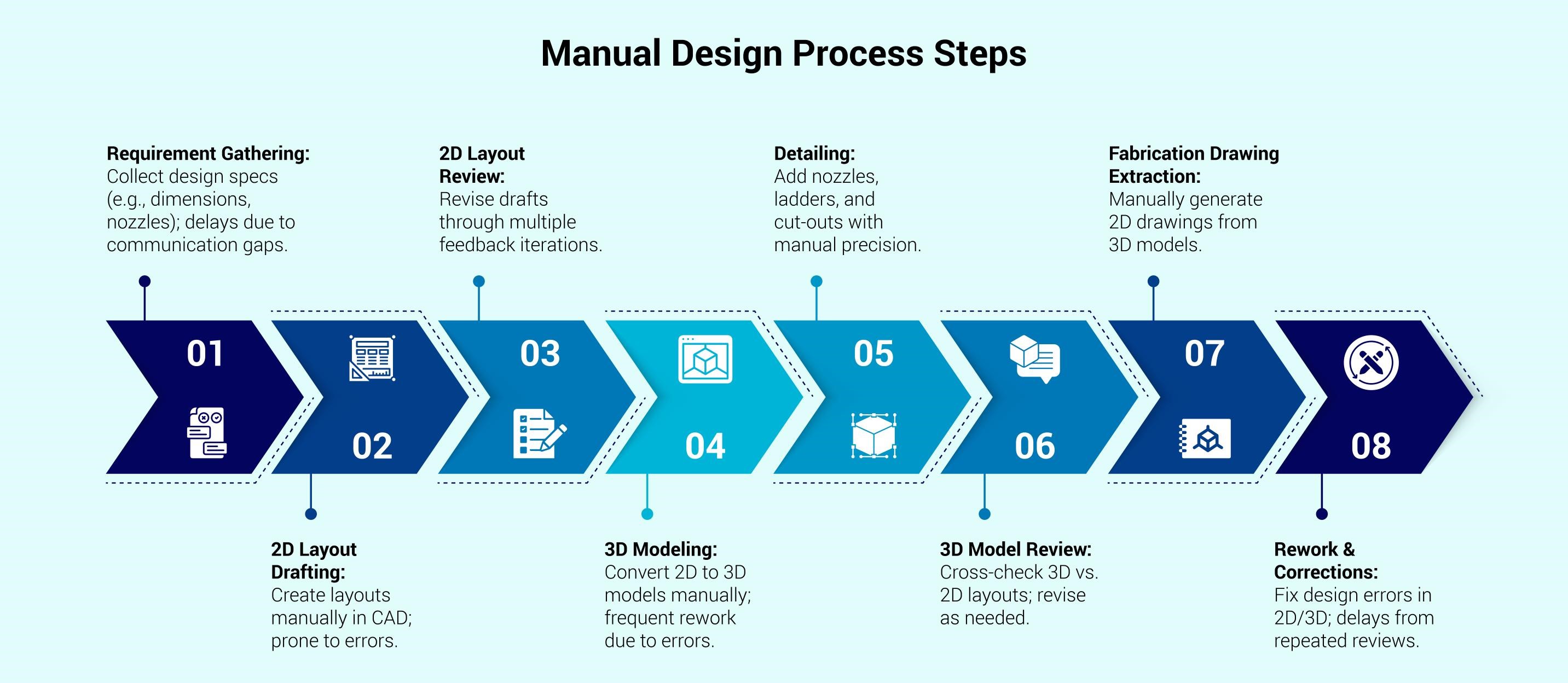
Manual Design Process Steps
1. Requirement Gathering: Collect design specs (e.g., dimensions, nozzles) with team collaboration; delays due to communication gaps.
2. Initial Drafting (2D Layout): Create 2D layouts manually in CAD; prone to errors and misalignment.
3. Validation of 2D Layout: Review and revise drafts based on stakeholder feedback; multiple iterations are needed.
4. 3D Modeling: Manually convert 2D designs into 3D models; errors often require rework.
5. Adding Details to the 3D Model: Add nozzles, ladders, and cut-outs manually with precision.
6. Validation and Review of 3D Model: Cross-check 3D models with 2D layouts; revisions based on stakeholder input.
7. Finalization of Fabrication Drawings: Extract 2D drawings from 3D models; manually align with standards.
8. Rework and Corrections: Identify and fix errors in 2D and 3D designs; extend timelines due to repeated reviews.
Why Does Manual Design Take So Long?
- Human Error: Prone to mistakes during drafting and modeling.
- Rework: Frequent errors mean additional cycles of review and revision.
- Low Scalability: Unable to handle large volumes of designs efficiently.
- Inconsistent Accuracy: Manual efforts often lead to discrepancies in 2D and 3D outputs.
- Time-Intensive: Designing a single vessel can take up to 3–4 weeks.
How the Project Was Executed
To ensure the success of the automation initiative, nCircle Tech followed a structured and collaborative approach:
- Discovery Sessions: Conducted 2-3 days of dedicated discussions with the client team to understand their existing workflows, challenges, and goals.
- ROI Documentation: Created a detailed Return on Investment (ROI) document, highlighting the expected benefits, time savings, and cost reductions of the proposed solution.
- Estimates and Acceptance Criteria: Defined clear estimates for development timelines and established measurable acceptance criteria to align expectations with client requirements.
- Solution Development: Designed and developed the custom AutoCAD Plant 3D plugin, incorporating all critical parameters and functionalities tailored to the client’s needs.
- Deployment and Acceptance:
- Assisted the client team in deployment of the solution, ensuring smooth integration into their existing workflows.
- Conducted dedicated acceptance sessions to verify performance, address feedback, and ensure the client’s complete satisfaction.
This comprehensive execution strategy allowed nCircle Tech to deliver a high-quality, impactful solution that met the client’s specific requirements while minimizing disruption to their operations.
Reimagining the Process– Automation into Play with AutoCAD Plant 3D Solution
Rather than majorly altering their team’s workflow, nCircle Tech advanced it further by setting automation into the picture.
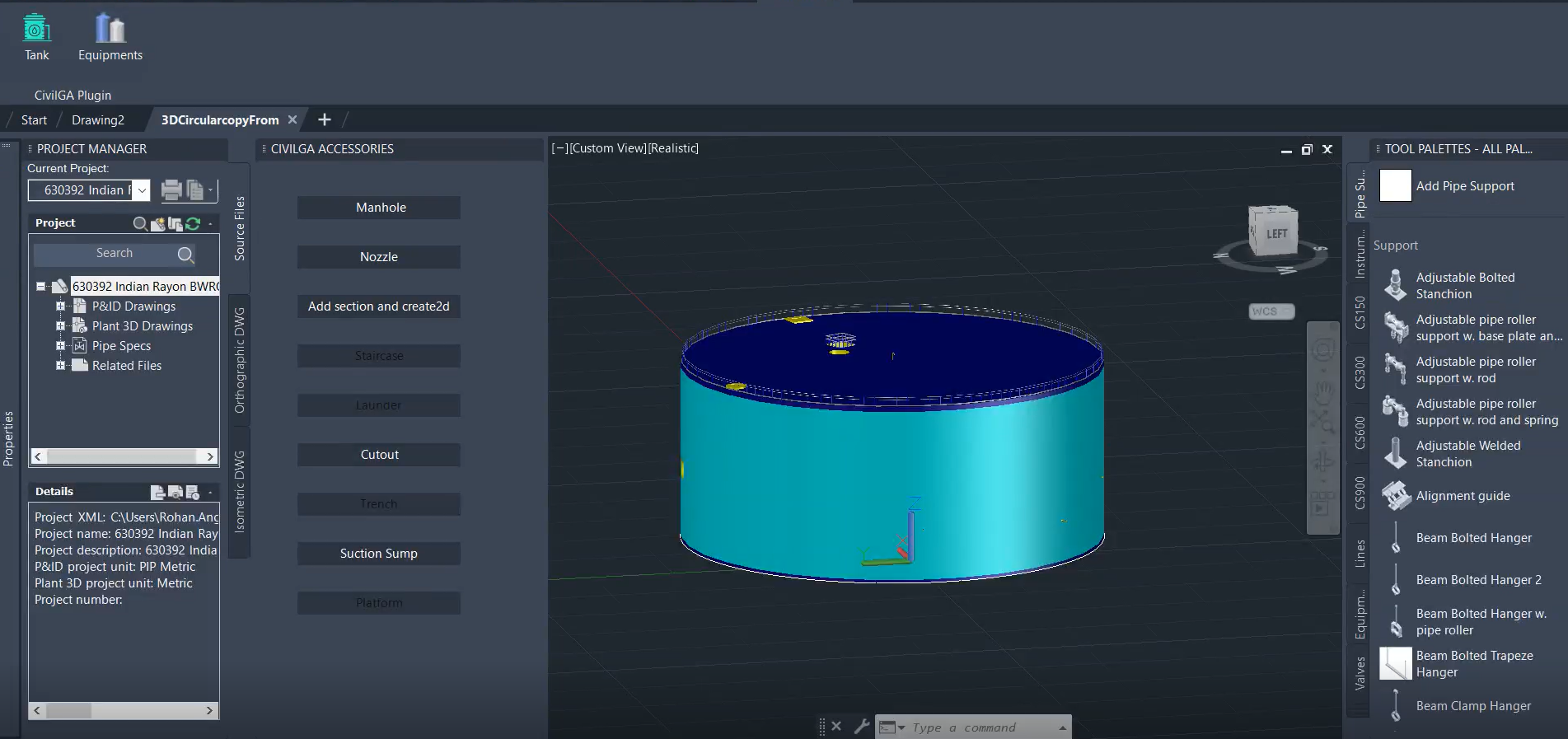
Our solution included the development of a custom AutoCAD Plant 3D plugin designed to automate the generation of 3D models and corresponding 2D drawings. By inputting critical parameters, the plugin produced precise and detailed visuals instantly, eliminating the need for time-consuming manual drafting.
Key Features of the Solution:
Input Parameters:
The plugin supports over 25 customizable input parameters, allowing flexibility in design. Key parameters include:
- Equipment dimensions (height, diameter, wall thickness)
- Nozzle placements (size, position, angle)
- Internal levels and compartments
- Cut-out specifications
- Manhole sizes and placements
- Ladder design and orientation
- Structural reinforcements and bracing
Automated Outputs:
- Instantly generates detailed 3D models based on the provided parameters.
- Produces corresponding 2D fabrication drawings, ensuring consistency and accuracy.
Customizable Options:
Tailored components for wastewater plant vessels, such as:
- Manholes (size, number, and placement)
- Ladders (design type, height, attachment points)
- Nozzles (varying diameters and angles)
- Cut-outs (specific dimensions and positions)
- Additional features like baffles, stiffeners, and support rings.
This automated solution not only reduced errors but also significantly enhanced design efficiency, ensuring consistent, high-quality results. The tool's ability to manage complex configurations and customizable designs allowed the client to achieve unparalleled precision and scalability in their operations.
Perks
- Reduced Design Time: Design time was cut by 95%, completing 2D and 3D design sets for equipment like tanks or vessels in just 5–6 hours instead of 3–4 weeks.
- Custom Equipment Design: The solution enabled the creation of tailored equipment designs, enhancing scalability and precision.
- Enhanced Fabrication Accuracy: Precise 2D drawings improved accuracy in the fabrication process.
- Optimized Workflow: The transformation minimized rework and delays, streamlining processes and saving costs.
- Automation Benefits: Automation reduced manual effort, leading to faster project completion.
nCircle Tech’s Innovation Route
Our team invested in understanding the primary pain points of the workflow. Through the route of process consulting, we identified that manual job were halting their productivity in equipment designing and other critical decisions.
An in-depth study led us to innovate a custom software solution using API for the manufacturing and plant industry. By simplifying the complex workflow, we achieved a seamless digital transformation powered by an advanced plugin-based solution.
nCircle Tech followed a systematic approach to ensure the development of a tailored solution that maximized value and met the client's unique needs. Here’s how we approached it:
- Created ROI Document: nCircle team developed an ROI document to outline potential returns from automation.
- Feasibility Assessment: Quickly identified which solutions were feasible and which automations were infeasible.
- Prioritized Automations: Ranked automation opportunities based on minimum effort required and maximum value delivered.
- Continuous Feedback Integration: Regular feedback sessions ensured the development of a tailor-made solution perfectly aligned with the customer’s needs.
- Scalability: With this automation, the approved design space is part of the automation. This allowed customer to let Junior engineers also design without worrying about the engineering issues. This means more number of people are now available for the design and expert time is utilized only for corner cases.
Outputs that Speak Quality and Quantity
In innovation, the goal isn't just about numbers—it's about delivering quality results. Our plugin-based automation helped the client scale operations, enhance efficiency, and set a new standard for precision in engineering equipment design.
At nCircle Tech, we believe in the power of collaboration with technology to unlock the full potential of workflows.