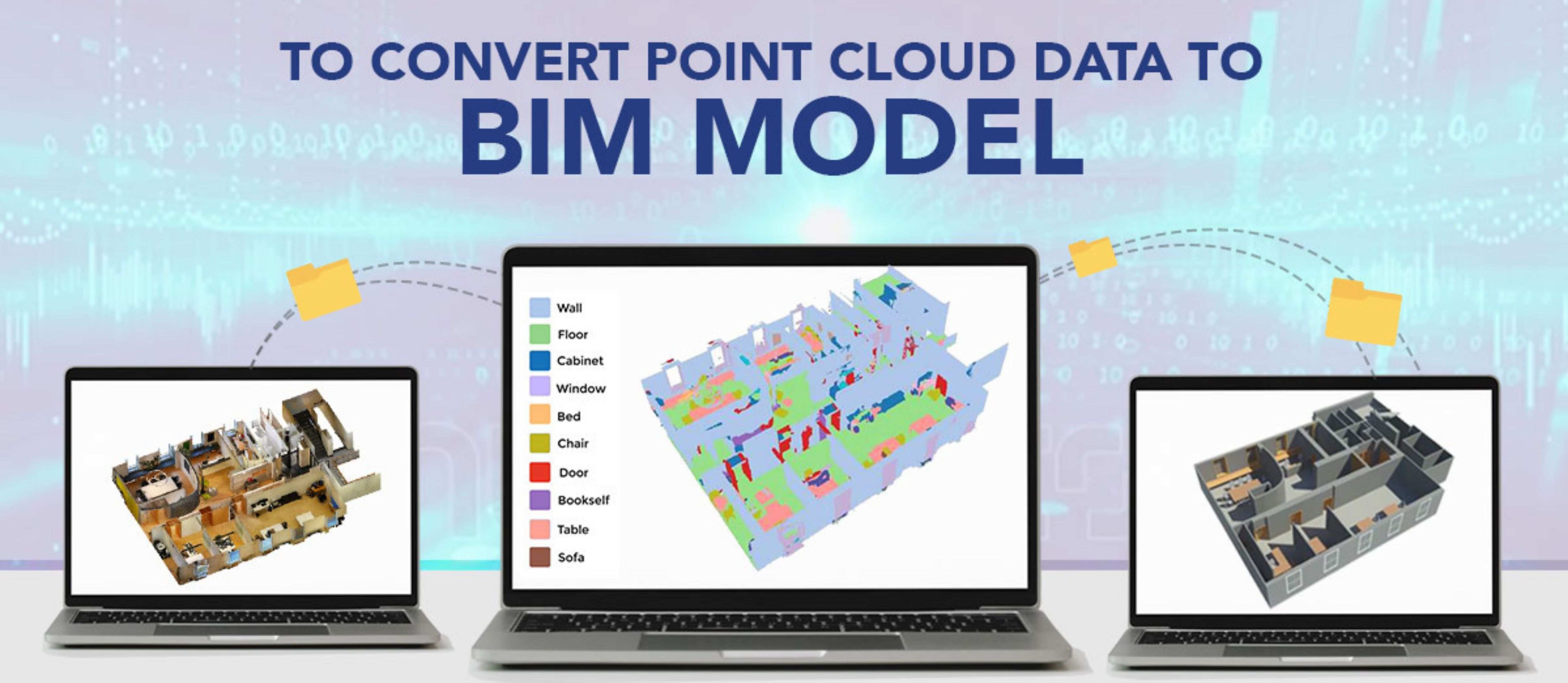
Emerging Trends in Point Cloud to BIM: The Future of AEC Technology
Digital tools are serving as transforming the AEC industry, streamlining workflow and enhancing productivity. As modern designs embrace complexity in their design and building systems, the reliance on technologies like point cloud, AR/VR, and digital twins is set to become a standard skillset for AEC professionals over the next 5-10 years.
Among these tools, point cloud to BIM services stands out– redefining AEC projects’ accuracy and efficiency. While BIM has emerged as one of the most powerful tools for 3D visualisation and coordination, point cloud to BIM helps trace a digital twin of what already exists.
Let’s understand in-depth about the point cloud to BIM technology and how it has advanced.
Top Industries & Real-World Applications
- AEC Industry – Enables precise digital representations of buildings, infrastructure, and sites.
Example: Used in heritage restoration to create accurate digital twins via laser scanning.
- Product Design & Manufacturing – Assists in virtual modelling of real-world components, minimising downtime and improving decision-making.
- Surveying & Geospatial Departments – Simplifies topographic mapping & terrain modeling.
Example: Drones with LiDAR scan rocky terrains for fast, accurate 3D mapping.
Are you curious to know how this advanced tool can benefit your project? Explore our Scan to BIM brochure.
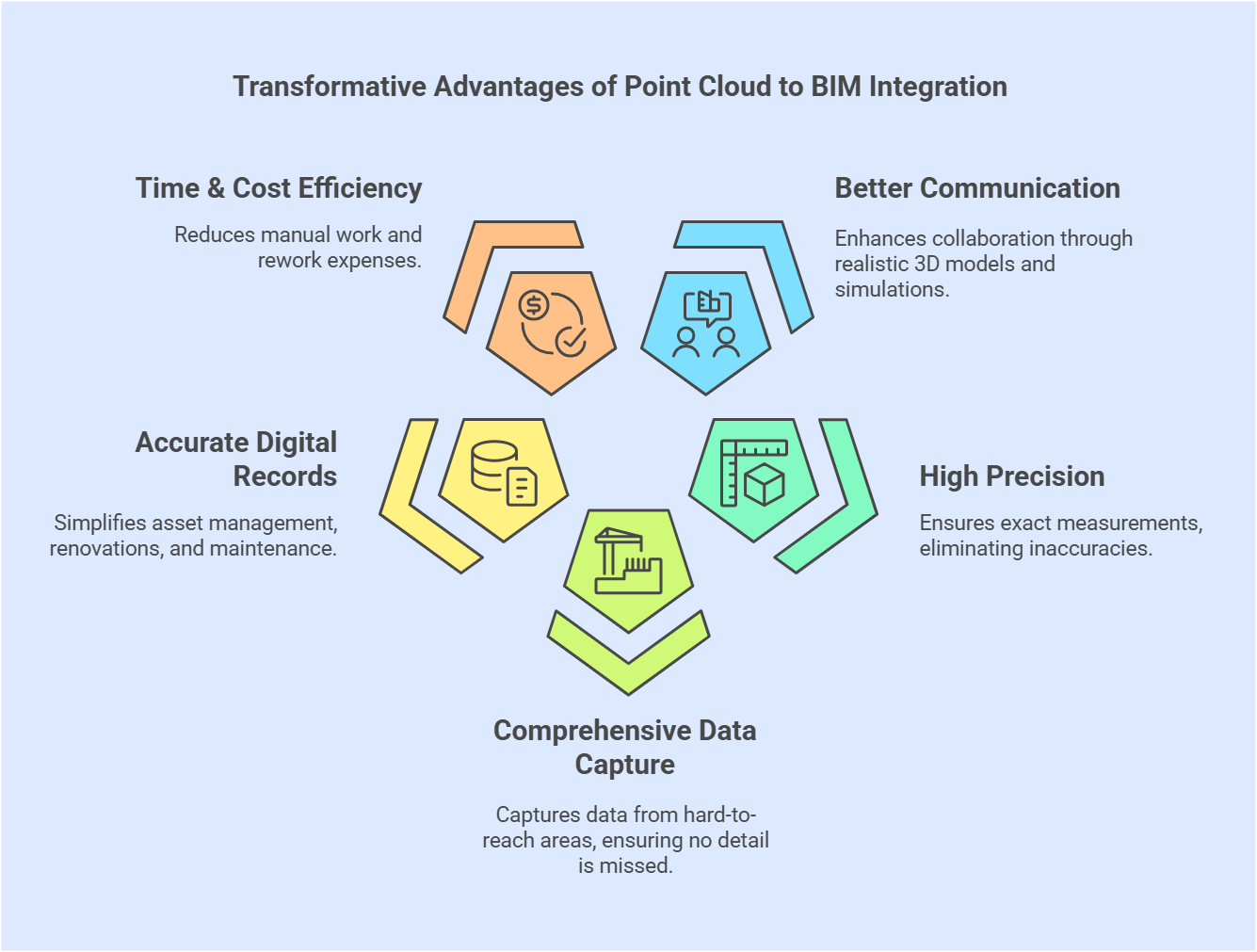
Why Point Cloud to BIM is Revolutionizing Digital Transformation
Point cloud data helps bridge the gap between the actual and the virtual. Let’s explore the unparalleled advantages offered by this robust tool.
What’s Emerging in the Point Cloud to BIM Services in 2025?
While we already know that the point cloud is ruling the current AEC landscape, let’s unveil what the future holds.
1. Better Speed with the Adoption of LiDAR
We can no longer rely on the slow and tedious job of site or building analysis and documentation. The need of the hour is a quicker and more efficient workflow.
This is where laser technology like LiDAR and drones are gaining popularity, speeding up tasks.
The advanced tools use laser technology to attain precise measurements for accurate 3D models. Tasks that once took weeks will now be completed within a few hours.
2. Enhanced Connectivity with Mobile Applications
Why rely solely on large systems when smartphones can now capture and process data?
The future is all about better connectivity and easily accessible data. Cloud-based solutions are advancing, transforming the conventional ways of scanning, storing, and accessing data.
The mobile applications facilitate better collaboration and make the process handy.
3. Clear Visualisation with AR and VR
AR/VR is no breaking news for the AEC industry. However, technology is stepping into the point cloud services, too. This integration will make the visualisation even more clear, immersive and decision-making more informed.
One of the biggest advantages of AR and VR technology is the ability to make designs comprehensible to the clients.
4. Minimised Risks and Errors with AI and ML Integration
Despite its precision, manually modelled point cloud to BIM data is still prone to errors.
This is where machine learning and automation have a major role to play. AI-powered tools automatically extract the point cloud data, transforming it into error-free models.
How does it benefit the workflows?
- Seamless facility management
- Quality control
- Enhanced building operations and performance
Point Cloud to BIM– The Unfolding Necessity
As the AEC industry evolves, point Cloud to BIM technology is setting new benchmarks for accuracy, speed, and collaboration. The integration of LiDAR, AI, AR/VR, and mobile applications is shaping a future where efficiency and precision are no longer aspirations but realities.
Explore more about the advanced potential of point cloud services, https://ncircletech.com
FAQs
1. What is a point cloud?
A collection of data points representing a 3D object, attained through laser scanning.
2. Which software is used for the conversion of point cloud data into a 3D model?
Autodesk Revit, SketchUp, Bentley MicroStation, etc.
3. What is the purpose of point cloud to BIM?
For accurate digital twins, renovation, site analysis, and 3D modelling of an existing structure.