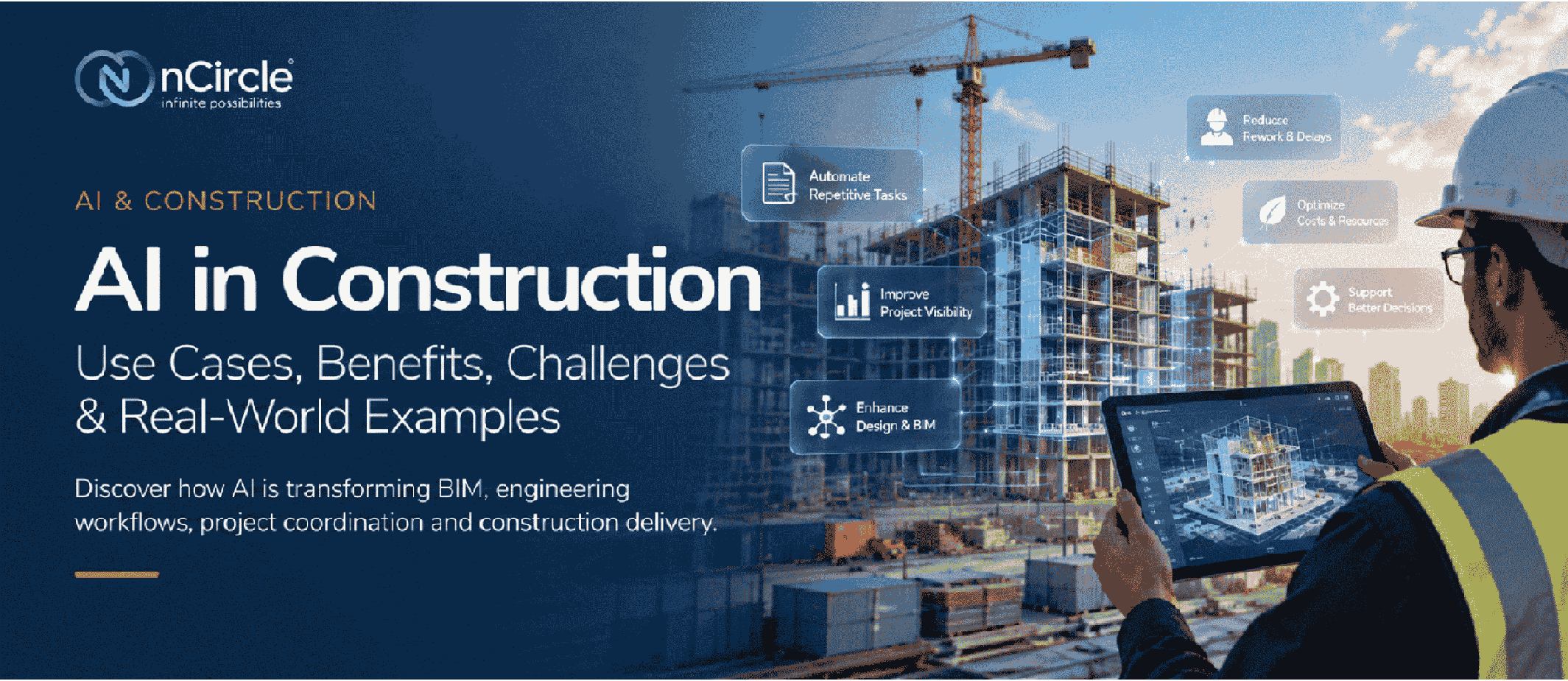
AI in Construction: Use Cases, Benefits, Challenges and Real-World Examples
Artificial intelligence (AI) in construction is the use of technologies such as machine learning, computer vision, natural language processing and generative AI to improve how construction projects are designed, planned, coordinated, delivered and managed. These technologies can help AEC companies automate repetitive engineering tasks, extract information from project documents, analyze BIM and point-cloud data, and make better use of project information.
However, successful AI adoption is not simply about introducing a new tool. It requires identifying the right workflow, connecting reliable data, validating results and measuring business outcomes.
For construction companies, the most practical starting point is often a specific, repetitive process where manual work, delays or data inconsistencies create measurable problems.
Why Is AI Becoming Important in Construction?
Construction projects involve large amounts of technical information, changing requirements, multiple stakeholders and complex handoffs between design, engineering, procurement and site teams. Information may be distributed across drawings, BIM models, spreadsheets, project management platforms and document repositories.
When teams have to search for information manually, repeat the same checks across multiple models or re-enter data into disconnected systems, valuable time is lost.
AI can help address these challenges by processing information, identifying patterns and supporting routine decisions. When combined with workflow automation and well-connected systems, it can help teams reduce repetitive effort and focus more time on engineering, coordination and decision-making.
The opportunity is growing, but implementation still matters. Autodesk's 2025 State of Design & Make: Spotlight on Construction report surveyed more than 3,500 industry leaders and experts across 28 countries. It found that 68% of respondents believed AI would enhance construction, down from 80% in the previous year. This suggests that expectations are becoming more measured as companies confront the practical challenges of adoption.
The lesson for construction businesses is clear: AI should be evaluated by the problems it solves and the results it delivers, rather than by the technology alone.
Read Autodesk's 2025 construction research.
What Are the Main Applications of AI in Construction?
AI can support different stages of the construction lifecycle, from early design and preconstruction to project execution and asset operations. The most suitable application depends on the available data, the existing workflow and the level of human review required.
1. AI for Design and BIM Workflows
Building Information Modeling (BIM) gives project teams a structured digital representation of a building or infrastructure asset. AI can add value by helping process model-related information, identify patterns and support engineering tasks.
Potential applications include:
- Reviewing model information to identify missing or inconsistent data.
- Assisting with the classification and interpretation of building elements.
- Supporting the analysis of large design datasets.
- Helping automate repetitive engineering tasks.
- Making technical information easier to retrieve and interpret.
AI does not replace every existing BIM automation tool. Many model checks are best handled by deterministic, rule-based software that applies explicit project requirements consistently. AI can complement these checks where information is unstructured, classification is difficult or interpretation requires context.
Construction teams can explore nCircle Tech's BIM and CAD workflow automation services to understand how repetitive engineering processes can be streamlined.
2. Machine Learning for Scan-to-BIM
Scan-to-BIM converts real-world conditions captured through laser scanning or other reality-capture methods into a Building Information Model.
Traditional workflows can require substantial manual effort to interpret point clouds, identify building components and create corresponding model elements. Machine learning can help identify patterns and recognize objects in point-cloud data, supporting parts of this conversion process.
Possible benefits include faster model preparation, less repetitive manual work and more efficient processing of large datasets. The final results must still be checked against project specifications and the required level of detail.
A practical example from nCircle Tech
In a published case study, nCircle Tech describes using machine learning to identify MEP elements and other entities in scanned point-cloud data, then converting the data into 3D BIM models. The project involved scanned data from hundreds of residential flats, each approximately 160 square metres. The team delivered the requested BIM model within the required timeline, and nCircle reports that its Scan-to-BIM solution can save up to 50% of the time compared with its traditional process.
These results belong to the specific workflow described in the case study; actual outcomes depend on project conditions, input data and modelling requirements.
Read the complete Scan-to-BIM case study.
3. AI for Construction Documents and Project Information
Construction projects generate a significant volume of information, including specifications, drawings, RFIs, submittals, meeting minutes, inspection reports and change documentation.
Natural language processing, document extraction and generative AI can help teams:
- Extract relevant information from documents.
- Summarize lengthy reports and technical correspondence.
- Find information across large document collections.
- Identify recurring themes in project issues.
- Draft summaries for human review.
- Connect information from multiple systems when appropriate integrations are available.
For example, a project manager may need to identify all overdue RFIs associated with a particular trade or location. A connected AI assistant could help retrieve the relevant records and summarize their status without requiring the manager to search several screens manually.
The reliability of these results depends on document quality, permissions, integration with the correct data sources and the ability to verify the underlying records. AI-generated answers should not be treated as authoritative merely because they sound confident.
4. AI for Project Planning, Cost and Risk Analysis
Construction schedules, cost estimates and project records contain useful information about resource requirements, delays, variations and delivery risks.
Machine learning and predictive analytics can help identify patterns in historical project data and highlight areas that may require attention. Depending on the data and system design, applications may include:
- Identifying patterns associated with schedule delays.
- Supporting cost forecasting and estimating.
- Highlighting unusual cost or resource variations.
- Identifying recurring sources of rework.
- Helping project leaders prioritize issues for investigation.
These tools provide decision support, not certainty. A model trained on incomplete or unrepresentative historical data may produce misleading results. Project teams should validate predictions against current conditions, contractual requirements and expert judgment.
5. AI for Quality Checks and Construction Coordination
Quality assurance and coordination often involve repeated reviews against defined requirements. AI can assist with interpreting information and prioritizing potential issues, while rule-based automation can handle explicit checks that can be expressed as consistent rules.
For example, automated BIM model checks may help identify pipe-slope issues, workset inconsistencies, mounting errors or defined clash conditions. These are examples of tasks that can be addressed through rule-based automation; they should not automatically be described as AI capabilities.
nCircle Tech's BIM Model Rule Checker automates selected rule checks in Autodesk Revit and generates compliance reports.
The important distinction is that AI and conventional automation can work together. Use AI where interpretation and pattern recognition are useful, and use explicit rules when a requirement needs to be checked consistently against defined criteria.
6. AI Assistants for Project Reporting and Decision Support
Project teams need timely access to information about open issues, RFIs, submittals, drawings and project progress. Gathering this information manually can consume time that could be spent resolving the underlying problems.
An AI assistant connected to the appropriate project systems can let users ask questions in natural language, retrieve relevant information, summarize issues and prepare reports. Connected data can also support portfolio-level analysis when information from several projects is available.
For example, a project leader may ask which RFIs remain overdue, which issues are blocking progress, or what has changed since the previous status review.
The quality of the answer depends on access permissions, data freshness, integration reliability and traceability to the original information. Teams should retain human review for important contractual, financial, engineering and safety-related decisions.
See nCircle Tech's AI-powered assistants for AEC for an example of AI-assisted project intelligence connected to Autodesk Construction Cloud.
What Are the Benefits of AI in Construction?
The benefits depend on the workflow and how well the solution is implemented. When a use case is properly selected and measured, AI can contribute to several business outcomes.
Reduced repetitive work: Automating suitable manual tasks allows engineers and project teams to spend more time on activities that require professional judgment.
Faster information retrieval: AI-enabled document search and project assistants can reduce the time spent locating and summarizing information across connected systems.
More consistent processes: Standardized automated checks can help teams apply the same rules repeatedly instead of relying entirely on manual review.
Better visibility into project risks: Analytics can help highlight patterns, exceptions and potential issues that deserve attention.
More efficient use of project data: AI can help turn information spread across documents, models and platforms into something teams can search, analyze and use.
Improved operational capacity: By reducing the effort required for selected workflows, companies may be able to process more work with their existing teams. Whether this creates measurable financial value must be demonstrated through project results.
These benefits should be treated as outcomes to validate, not guaranteed results of purchasing an AI solution.
How Should Construction Companies Start Implementing AI?
Construction companies do not need to automate an entire project lifecycle at once. A more practical approach is to begin with a specific workflow and expand only after the value has been demonstrated.
Step 1: Identify a measurable problem
Start with a task that repeatedly consumes time, creates avoidable errors or delays decisions. Examples include processing scanned data, searching project documentation, preparing routine reports or checking BIM models against defined requirements.
Describe the problem in operational terms rather than beginning with a preferred AI tool.
Step 2: Understand the current workflow
Document who performs the task, what information they use, how many handoffs are involved, where errors occur and how long the process takes.
This establishes a baseline against which an automated workflow can be evaluated.
Step 3: Assess data readiness
Review whether the required information is accessible, accurate, current and legally available for the intended use. Check file formats, permissions, missing information, integration needs and security requirements.
A sophisticated AI model cannot reliably compensate for fundamentally poor inputs.
Step 4: Choose the right technology
Not every problem requires generative AI.
- Use rule-based automation when requirements are explicit and repeatable.
- Use machine learning when patterns in data can support classification or prediction.
- Use computer vision when visual information, images or point clouds need to be interpreted.
- Use generative AI when language-based tasks such as summarization, information retrieval or drafting are suitable.
- Combine approaches when a workflow requires more than one capability.
The decision should follow the problem, not the popularity of a particular technology.
Step 5: Run a controlled pilot
Test the chosen workflow using representative project data and a defined set of success criteria. Involve the people who will use the output, and compare the results with the existing process.
Record errors, review time, exceptions and the amount of human intervention required.
Step 6: Measure results against the baseline
Assess whether the pilot improved the original process. Consider time saved, error rates, rework, output quality, user adoption, operating costs and the effort needed to maintain the solution.
Include integration, training, monitoring and human-review costs when evaluating the business case.
Step 7: Scale with oversight
Expand the solution only when the pilot has demonstrated reliable results. Define responsibilities for access control, data protection, model monitoring, quality review, incident handling and ongoing maintenance.
This makes AI adoption a controlled operational improvement rather than a one-time software deployment.
How Can You Measure the ROI of AI in Construction?
AI projects should be evaluated against the problem they were selected to solve. Useful metrics include:
What Are the Challenges of AI Adoption in Construction?
AI implementation in construction involves practical challenges that need to be addressed before a solution is scaled.
Fragmented data: Project information may be spread across platforms, file formats and teams, making it difficult to establish a reliable source of truth.
Inconsistent inputs: Poorly structured documents, incomplete models and inconsistent records can reduce output quality.
Integration complexity: AI systems may need to connect with BIM applications, document repositories, project management platforms or enterprise systems.
Security and confidentiality: Companies must define how project data is accessed, stored, processed and shared, including whether the chosen provider's terms permit the intended use.
Unreliable outputs: AI may misinterpret documents, miss relevant information or generate incorrect answers. Verification mechanisms are essential.
Workforce adoption: Teams need to understand when to use the technology, how to evaluate its outputs and when to escalate issues.
Unclear ROI: An impressive demonstration does not establish that a solution will create value in a live project environment.
A successful implementation addresses these challenges as part of the workflow design, rather than treating them as problems to solve after deployment.
Is AI Going to Replace Construction Professionals?
AI is better understood as a capability that can support selected tasks than as a wholesale replacement for construction professionals.
AI can assist with processing information, automating repetitive checks, summarizing documentation and identifying patterns. Architects, engineers, BIM specialists, contractors and project managers still provide contextual judgment, validate outputs, handle exceptions and take responsibility for professional decisions.
The objective is to reduce unnecessary manual effort while preserving the expertise, accountability and quality controls required to deliver construction projects successfully.
Frequently Asked Questions About AI in Construction
What is AI in construction?
AI in construction is the use of artificial intelligence technologies to support tasks such as design analysis, document processing, BIM workflows, project reporting, quality checks and risk assessment. The specific application depends on the problem, data and level of human oversight required.
How is AI used in the construction industry?
AI can support machine-learning-based Scan-to-BIM, document intelligence, natural-language search, project reporting, predictive analytics and selected design or quality-control workflows. Rule-based automation often complements these applications when requirements are explicit and repeatable.
What are the main benefits of AI in construction?
Potential benefits include less repetitive manual work, faster access to project information, more consistent checks, improved visibility into potential risks and better use of available data. Actual results depend on the use case, integration quality and implementation.
How can a construction company start using AI?
Start by identifying one measurable problem, documenting the current workflow, checking data readiness, selecting a suitable technology and testing it in a controlled pilot. Measure quality, time, cost and adoption before expanding the solution.
Does AI require BIM or digital construction software?
Not every AI application requires BIM. Document processing, reporting and analytics can operate on other types of project data. However, AI applications intended to interpret model elements, point clouds or connected digital project information need appropriate data sources and integrations.
Is AI in construction safe and reliable?
AI reliability depends on the quality of its data, the system's design, the use case and the safeguards in place. Important engineering, safety, financial and contractual decisions require appropriate verification, access controls and accountable human review.
What is the difference between AI and construction automation?
Traditional automation typically follows predefined rules to execute repeatable tasks. AI can additionally help interpret unstructured information, recognize patterns, generate language or make predictions. Many practical construction workflows combine both approaches.
Final Thoughts: Make AI Practical Before Making It Bigger
AI in construction offers opportunities across BIM, engineering automation, document intelligence, project reporting and decision support. But the value does not come from adopting AI for its own sake. It comes from identifying a genuine workflow problem, selecting the right technology and proving that it improves the process.
For construction companies, the strongest starting point is a defined use case with accessible data, measurable outcomes and appropriate quality controls. Once the solution demonstrates value, it can be improved and extended to related workflows.
nCircle Tech works across AI and machine learning, BIM, CAD workflow automation and connected engineering systems. To explore where these technologies could fit into your organization's workflows, visit our AI and Machine Learning Services page or contact nCircle Tech to discuss your requirements.