
BIM Technology role of innovation, Transformation in AEC: Keys to Understanding the Europe & Middle East Market
Today, AEC's power lies in advanced construction technology. Traditional workflows can no longer keep pace with the demands of modern construction. Rather, advanced tools like BIM technology and automation are driving the change with smarter and more efficient results.
In Europe and the Middle East, the adoption of transformative technologies is reshaping workflows, boosting efficiency, and fostering sustainability. Let’s explore the trends revolutionizing the AEC landscape.
The Transforming Market Practices
With the advent of artificial intelligence and generative AI, industries across the board are reshaping their workflows for faster, smarter, and more efficient outcomes. When it comes to the AEC sector, AI technology is addressing critical challenges and unlocking new possibilities.
Here’s how AI is driving a transformation in the typical AEC landscape:
- The automation of repetitive and time-consuming tasks helps in serving the critical concern of labour shortage in the industry.
- AI-powered energy analysis of buildings ensures energy-efficient and sustainable designs complying with environmental standards. For example, Germany’s initiative to reduce emissions by 68% by 2030, calls for real-time sustainability analysis, where AI steps in for enhanced precision and efficiency.
- Almost 90% of AEC firms have either adopted or plan to adopt digital tools into their workflow. It has comparatively lowered the initial upfront costs, enabling even small or medium-sized organisations to experiment with AI. 55% of the Gulf construction professionals view sustainability as the key factor towards innovation and AI adoption.
- With Generative AI, firms can create and refine multiple design proposals in record time, improving their chances of winning bids.
- Advanced technology enables faster project turnarounds with greater efficiency. For instance, Saudi Arabia's Vision for 2030, which focuses on rapid mega-project development, heavily relies on advanced tools and modular construction to meet its ambitious targets.
As the industry heads toward digital workflows, let’s explore the technological trends leading this transformation.
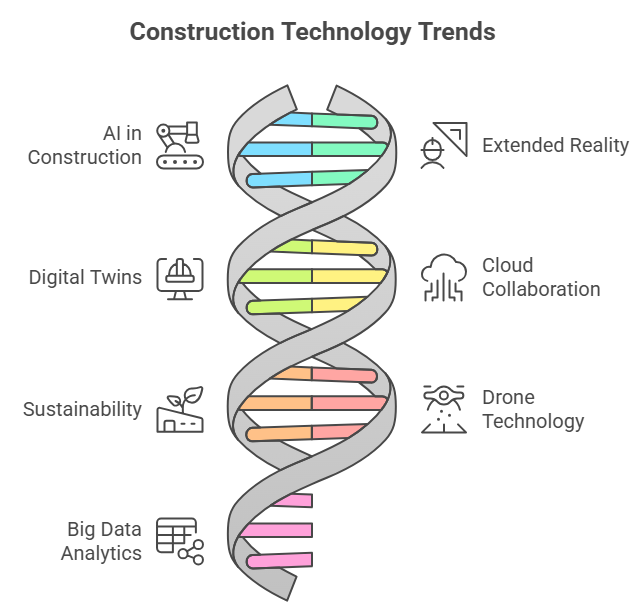
Levelling Up the Resilience– Top Construction Technology Trends
1. Unlocking Possibilities with AI
AI has paved its path into the construction sector, slowly, becoming a core element of modern construction technology. The integration of artificial intelligence in the AEC workflows enhances design processes, project management, and overall operational efficiency.
Key applications of AI integration in the AEC workflow are:
- Generative AI for design iterations in no time.
- Clash detection before execution.
- Enhanced energy and performance efficiency.
- Automation of repetitive tasks.
And the perks?
- Minimised errors and reworks
- Enhanced quality
- Workforce efficiency
- Quicker turnarounds
- Sustainable solutions
As the industry faces challenges like labour shortages and the demand for eco-friendly solutions, AI offers a way forward.
2. Advanced Communication with Extended Reality (XR)
Revolutionising communication and collaboration in AEC. These immersive tools offer stakeholders an unparalleled ability to visualise and interact with designs before construction begins.
The market value for AR, VR, and MR, is expected to grow with a CAGR of 113.2% to reach a value of USD 250 billion by 2028.
The applications, driving this growth are:
- Design visualisation
- Training and remote collaboration with the stakeholders
- Advanced pre-visualisation
With XR, stakeholders can make informed decisions faster, reducing miscommunication and improving project outcomes.
3. Evaluating the ‘What-ifs’ with Digital Twins
In today’s fast-paced AEC landscape, waiting for construction to finish to evaluate the outcome is no longer an option. This is where digital twins are bridging the gap between visualisation and reality.
Digital twins empower AEC professionals to gain detailed insights into a building’s performance and functionality before it’s even constructed. With real-time updates and data integration, designers can simulate and evaluate ‘what-if’ scenarios, enabling them to refine designs for optimal efficiency and performance.
4. Collaborating with Cloud Technology
Accessing data is no longer a challenge. Today, the collaboration has become effortless with cloud technology platforms like BIM 360 coming into the AEC landscape.
Cloud systems serve as the centralised hub for data, hosting extensive information about the project and ensuring that every detail is accessible in real-time. With data available anytime, anywhere, stakeholders can seamlessly collaborate and make informed decisions, regardless of their location.
Perks?
- No geographical barriers to data sharing.
- Cohesive collaboration amongst stakeholders.
- Minimised clashes.
- Project efficiency.
- Lesser reworks.
5. AEC Technology X Sustainability
In the current AEC landscape, sustainability is non-negotiable.
AEC technology is playing an active role in the delivery of projects with minimised carbon footprints. Innovative AI tools help analyse the environmental impact of the design during the design phase, and data-driven insights aid in the designing of energy-efficient structures.
6. Tracking and Documenting with Drones
From pre-construction analysis to progress monitoring, drones are transforming how projects are planned and executed. An in-depth analysis of structure, neighbourhood, potential obstructions and advantages helps in better decision-making.
Furthermore, drones help refine the construction planning and estimation with detailed aerial views of the site. Drone imagery also aids in real-time documentation and progress tracking.
7. Predictions with Big Data
Big data is the powerhouse behind informed decision-making in AEC. By integrating AI with BIM, firms can leverage vast datasets for predictive analytics.
For example, at nCircle Tech, we employed big data analytics for a U.S.-based real estate company to filter over 10,000 properties across three cities. Using an ML-based system, we provided precise, real-time insights, enabling efficient pre-qualification and ranking of properties.
Here are the top benefits of big data in AEC:
- Enhanced design accuracy
- Prevention of clashes and delays
- Optimized building performance
- Cost and time savings
A Shift Toward Smarter, Better Results
The adoption of advanced AEC technologies isn’t just about improving workflows; it’s about transforming the industry. From AI and XR to drones and big data, these tools are enabling professionals to collaborate seamlessly, deliver sustainable projects, and avoid costly delays.
Are you ready to build smarter, faster, and more sustainably? Contact us today, at info@ncircletech.com.