Revolutionising AEC: The Role of AI Agents in Digital Transformation
The construction industry has long struggled with inefficiencies, budget overruns, and complex decision-making. Despite decades of software advances, large projects still exceed budgets by up to 80% and face average delays of 20%. The message is clear: traditional digital tools are not enough.
Unlike traditional automation tools, AI agents are intelligent software assistants that work autonomously, adapt to project data, and deliver proactive insights and recommendations. In the AEC industry, they offer a powerful way to bridge the gap between data and decision-making, especially in environments where tight timelines and resource efficiency are crucial. They’re not merely tools; they’re partners in navigating the complexity of modern construction.
From Automation to Agency: What Sets AI Agents Apart
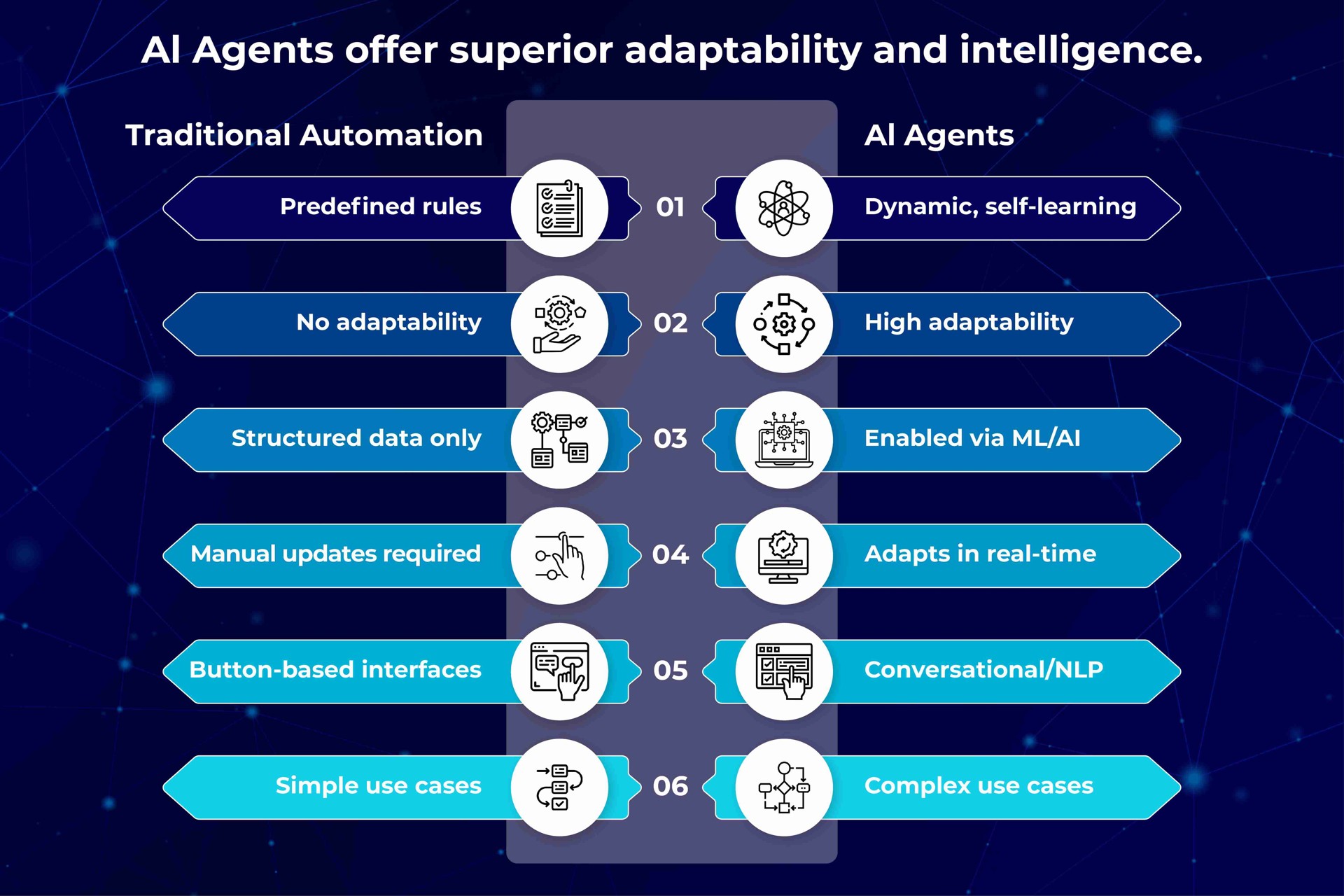
Most software in AEC today is rule-based: it performs specific tasks when prompted. AI agents go far beyond this. They operate on a cycle of:
- Observing real-world inputs
- Planning responses tailored to specific project contexts
- Executing tasks with minimal human oversight
- Learning from outcomes to improve future actions
Agentic AI is stepping out of the passive role and into the driver’s seat, designed to autonomously plan, execute, and adapt to make autonomous decisions based on its environment and carry out tasks within its operational scope.
A perfect example is AI-driven Scan to BIM. These systems analyse point clouds, automatically label components, and generate as-built BIM models - delivering results with a speed and accuracy human teams simply cannot match.
How AI Agents Are Already Changing Construction
Here’s where AI agents are already making an impact across the AEC lifecycle:
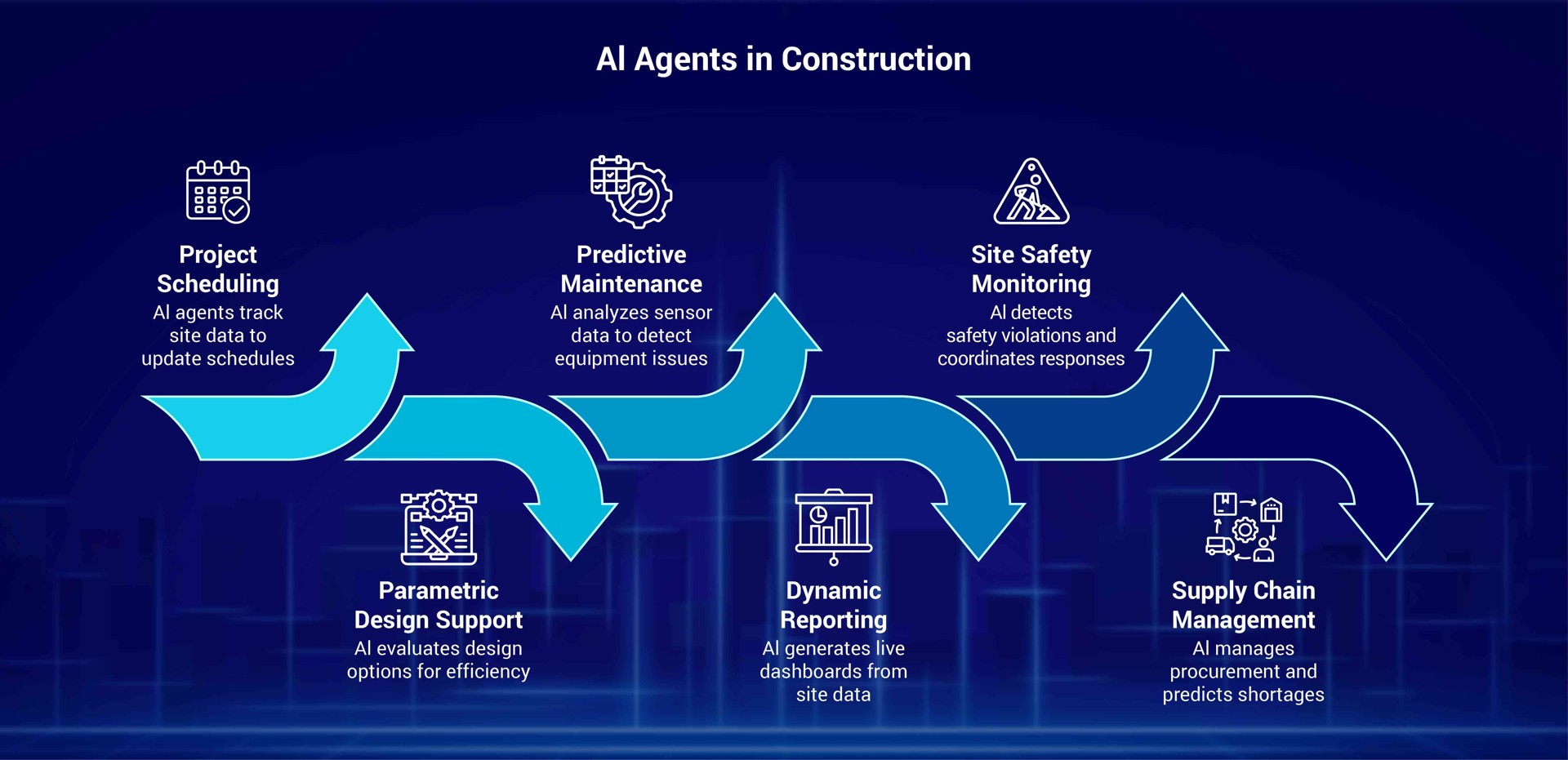
1. Project Scheduling and Real-Time Adjustments
AI agents track site data, like weather changes or material shortages - and automatically update project schedules to reduce delays.
2. Parametric and Generative Design Support
Agents evaluate material options, structural compliance, and energy efficiency, guiding teams toward smarter design choices.
3. Predictive Maintenance and Fault Detection
AI agents analyse sensor data to identify failing equipment before it disrupts projects.
4. Dynamic, Real-Time Reporting
Instead of static reports, AI agents generate dashboards that reflect live data from sites and BIM models.
5. Site Safety Monitoring
By integrating with cameras and sensors, AI agents detect safety violations and coordinate rapid responses.
6. Supply Chain and Procurement
Agents manage procurement timelines, predict shortages, and recommend adjustments to keep projects on track.
AI agents are even automating regulatory checks, approvals, and admin tasks - freeing human experts for higher-value work.
How nCircle Tech Brings AI Agents into AEC Workflows
At nCircle Tech, we’ve seen firsthand how AI agents redefine construction efficiency. Here are real-world examples from our portfolio:
AI Scan to BIM for Lightning-Fast Model Creation
The client, an Austrian digitisation agency, is involved in creating a sustainable digital experience for services and products. nCircle Tech delivered a complete BIM model from laser scan data within a compelling timeframe of 24 hours. This was made possible by AI Scan to BIM automation, replacing manual modelling with machine learning for automated BIM modelling from point clouds.
Point cloud to BIM AI for 3D modelling from 2D inputs
For a series of software based clients, nCircle used AI powered point cloud to Revit conversion to develop 3D models from legacy 2D drawings. The platform’s automated labelling in Scan to BIM for faster modelling helped reduce project rework and turnaround time.
Sustainability Insights Through Predictive Modelling
Using a cloud-based Scan to BIM platform for AEC professionals, nCircle provided insights into the most energy-efficient building configurations for a UK based leading scanning company. These tools contributed to lowering environmental impact and achieving net-zero goals.
Why Embrace AI Agents? The Benefits Are Clear
Integrating AI agents into construction workflows unlocks powerful benefits:
- Reduced manual hours → Free your team for high-value tasks
- Lower risk → Predictive analytics catch issues before they escalate
- Smarter decisions → Aggregated data delivers sharper insights
- 24/7 operations → AI never sleeps
- Cost savings → Efficient processes and fewer errors boost your bottom line
For construction teams looking to gain these efficiencies, now is the right time! Here you can explore how AI agent-driven tools and Scan to BIM workflows can fit into your existing operations. Schedule a demo with our AI-led construction workflow optimiser.
The use of automated Scan to BIM service for large projects is particularly effective in reducing modelling time. It also ensures a consistent output across all project stages.
Overcoming Challenges: Practical and Ethical Considerations
Although the advantages are significant, a number of issues need to be addressed prior to expanding AI agents in construction. Some of them include-
- The inaccessibility of clean, structured data for the project teams adds limitations to the capability of AI agents to provide effective outputs
- Certain field professionals display strong resistance towards implementing or learning new systems within the field.
- There remains a controversy surrounding decision accountability when AI agents operate independently.
- Integration with existing software packages can involve significant configuration.
- Governance, interpretability, and transparency are still key to large-scale adoption
AI agents are powerful, but only as effective as the data, systems, and team cultures they are embedded in
How to Start Your AI Journey
Here’s how to begin adopting AI agents without overwhelming your teams:
Step 1: Identify repetitive tasks - Start with processes like documentation, compliance checks, or as-built scans.
Step 2: Run a pilot - Implement AI on a small project - e.g. Scan to BIM for a single renovation.
Step 3: Measure results - Use clear metrics and team feedback to assess impact.
Step 4: Scale strategically - Integrate AI into broader workflows via BIM platforms and APIs.
The Future is Intelligent Construction
AI agents aren’t here to replace professionals - they’re here to supercharge them. These systems drive:
- Faster project delivery
- Greater cost certainty
- Safer job sites
- Data-driven sustainability
Cloud-based Scan to BIM platforms and agent-led automation are already redefining how we design, build, and manage facilities.
In the coming decade, the firms that thrive will be those that partner human expertise with the adaptive intelligence of AI agents.
Ready to transform your construction workflows?
Explore how nCircle Tech’s AI-powered solutions - from point cloud to Revit conversion to automated BIM modelling - can help you build faster, smarter, and more sustainably.