Unleashing Speed in Scan to BIM: How AI & ML Are Transforming Point Cloud to BIM Workflows in 2026
The Speed Problem in Scan to BIM
Speed is no longer a luxury in the AEC industry — it is a competitive requirement.
Every project manager who has commissioned a Scan to BIM service knows the bottleneck well. The laser scanner does its job in hours. The point cloud arrives. And then the wait begins. Manual segmentation, object-by-object interpretation, layer-by-layer modelling in Revit — days stretch into weeks before a usable BIM model is in anyone's hands.
In 2026, that bottleneck is no longer acceptable — and more importantly, it is no longer necessary.
Machine learning has fundamentally changed what is possible in the scan to BIM workflow. AI-powered automation is collapsing timelines, eliminating human error at scale, and enabling AEC firms to process larger, more complex point cloud datasets than ever before — faster and at a fraction of the traditional cost.
This blog unpacks exactly how that transformation is happening, what it means for your projects, and how nCircle Tech — a specialist in ML-powered BIM and CAD automation since 2012, and an established Autodesk technology partner — is leading it.

What Is Scan to BIM?
Scan to BIM is the process of converting real-world spatial data — captured through LiDAR laser scanning or photogrammetry — into an intelligent, data-rich Building Information Model. The workflow moves from physical reality to digital model through four stages: reality capture, point cloud processing, BIM model creation, and quality-controlled delivery.
Stage 1 — Reality Capture
A laser scanner or LiDAR device captures the physical environment as millions of geo-referenced data points, producing a point cloud file in e57, LAS, RCS, or RCP format. This stage can take hours for a single building or weeks for a large infrastructure asset.
Stage 2 — Point Cloud Processing
The raw data is cleaned, registered, and segmented to identify discrete structural and MEP elements: walls, floors, ceilings, columns, beams, ducts, pipes, and more.
Stage 3 — BIM Model Creation
Modellers — or increasingly, ML engines — interpret the segmented data and build a Revit, AutoCAD, or IFC model at the required Level of Detail (LOD 100 through LOD 400).
Stage 4 — Quality Control and Delivery
The model is validated against the original scan data, checked for dimensional accuracy, and delivered in the agreed format.
Point cloud to BIM conversion is the foundation of renovation, retrofit, facility management, heritage documentation, digital twin creation, and infrastructure asset management projects worldwide. To understand the emerging trends reshaping this field, see nCircle Tech's analysis on the future of AEC point cloud to BIM technology.

The Traditional Scan to BIM Workflow — Where Time Is Lost
Before AI entered the picture, the scan to BIM process was almost entirely manual — and manual meant slow, expensive, and inconsistent.
Here is where the time hemorrhaged in a conventional workflow:
- Manual point cloud segmentation — Technicians spent hours, sometimes days, manually classifying point cloud regions into structural categories. Every wall, every pipe, every beam required individual human judgement.
- Object interpretation errors — Dense point clouds in MEP-heavy environments or older buildings with irregular geometry were notoriously difficult to read. Misclassified objects created downstream rework that only surfaced after significant time had already been invested.
- Iterative Revit modelling — Even after segmentation, modellers rebuilt each element from scratch inside Revit, referencing the point cloud as a visual guide rather than a direct, machine-readable input.
- Late-stage quality control — Without automated deviation checking, discrepancies between the as-built reality and the BIM model were only discovered at the end — triggering expensive correction cycles.
A mid-complexity commercial building could take two to three weeks to process manually. A large infrastructure corridor could take months. For project teams working to tight handover schedules, this was an unsustainable constraint.
For a detailed examination of how automation is resolving these issues, see: Automation in Scan to BIM for Existing Buildings.
How ML & AI Are Unleashing Speed in Scan to BIM in 2026
ML-powered Scan to BIM automation replaces the slowest and most error-prone stages of the traditional workflow with machine intelligence. Here is how each stage accelerates:
Automated Point Cloud Segmentation
ML algorithms trained on large architectural and engineering point cloud datasets automatically classify scan regions in minutes. Walls, floors, ceilings, structural columns, beams, ducts, pipes, and cable trays are identified and labelled without human intervention. What previously took a skilled technician two full working days now takes an ML engine under an hour.
nCircle Tech's ML engine has been trained on over 800 GB of real-world point cloud data spanning residential, commercial, industrial, and infrastructure environments — giving it the contextual depth to handle varied and complex scan scenarios accurately.
AI-Powered Object Recognition and Feature Extraction
Beyond classification, AI object recognition identifies specific architectural and MEP components — their geometry, orientation, and spatial relationships — and maps them directly to Revit families or IFC object types. This eliminates the interpretation stage that consumed the majority of manual modelling time.
The system identifies not just what an object is, but how it connects to adjacent systems — enabling coordinated BIM model generation rather than isolated, element-by-element reconstruction.
Cloud-Based Elastic Processing
Speed is not only about algorithmic efficiency — it is also about infrastructure. nCircle Tech's scan to BIM automation services run on a cloud-based platform with elastic, scalable processing. Large datasets that would overwhelm a local workstation are processed in parallel across distributed cloud resources, delivering consistent performance regardless of project size. Projects that required two to three weeks manually are now delivered in 24 to 48 hours.
Automated Quality Assurance
Rather than relying on manual cross-referencing at the end of the process, ML-powered QA tools automatically detect deviations between the point cloud and the BIM model and generate structured error reports throughout the workflow. nCircle Tech's Deviation nSpector integrates directly into this pipeline — cross-referencing as-built scan data against the design model to deliver mathematically precise deviation analysis in seconds, not days.
For a practical framework on getting the most accurate results, see: Five Strategies to Get the Best Outcomes with Scan to BIM and Evaluating Advanced Scan to BIM Workflows: Optimising Data Accuracy and Project ROI.

Key Use Cases Driving Demand in 2026
The demand for fast, accurate, AI-powered scan to BIM is growing across five distinct use cases:
1. Existing Building Renovation and Retrofit
Renovation projects are accelerating globally — driven by net-zero retrofit requirements, urban regeneration programmes, and ageing building stock across Europe, the US, and India. AI-powered scan to BIM for existing building renovation is now the standard approach for capturing accurate as-built conditions before design work begins. See nCircle Tech's work on ML-powered solutions for carbon footprint reduction in residential buildings as a real-world example.
2. MEP System Detection and Modelling
MEP scan to BIM services represent one of the highest-value applications of ML automation. Mechanical, electrical, and plumbing systems in commercial and industrial buildings produce extraordinarily dense point cloud data — with pipes, ducts, conduits, and equipment overlapping in complex three-dimensional arrangements. ML-based MEP detection identifies each component's type, routing, and connectivity, producing coordination-ready models that would take manual teams weeks to reconstruct.
3. Facility Management and Digital Twin Creation
Scan to BIM is increasingly the starting point for digital twin platform creation. Facility managers need accurate, data-rich as-built models to underpin digital twin deployments for real-time monitoring, predictive maintenance, and lifecycle asset management. Combined with nCircle Tech's nBIM platform — which integrates BIM, point cloud, and GIS data — this creates a complete facility intelligence solution. See also: Leveraging Point Cloud Data for Digital Asset Management.
4. Infrastructure and Bridge Modelling
Large infrastructure projects generate massive point cloud datasets that have historically been impractical to convert manually at full fidelity. ML-powered laser scanning BIM services make infrastructure-scale conversion commercially viable. nCircle Tech's delivery of BIM modelling for 340+ Italian bridges in partnership with Alesi Design demonstrates the real-world scalability of this approach — documented in the Santiago-based laser scanning case study.
5. Construction Quality Control and As-Built Verification
Post-construction, scan to BIM combined with deviation analysis gives site teams an objective, rapid view of whether what was built matches what was designed. The Deviation nSpector and ML scan to BIM workflow together create a single automated pipeline from scan capture to verified, as-built documentation.

ML-Powered Scan to BIM vs. Manual Methods — A Direct Comparison
The case for automation is measurable. Here is how both approaches compare across the metrics that matter most to AEC decision-makers in 2026:
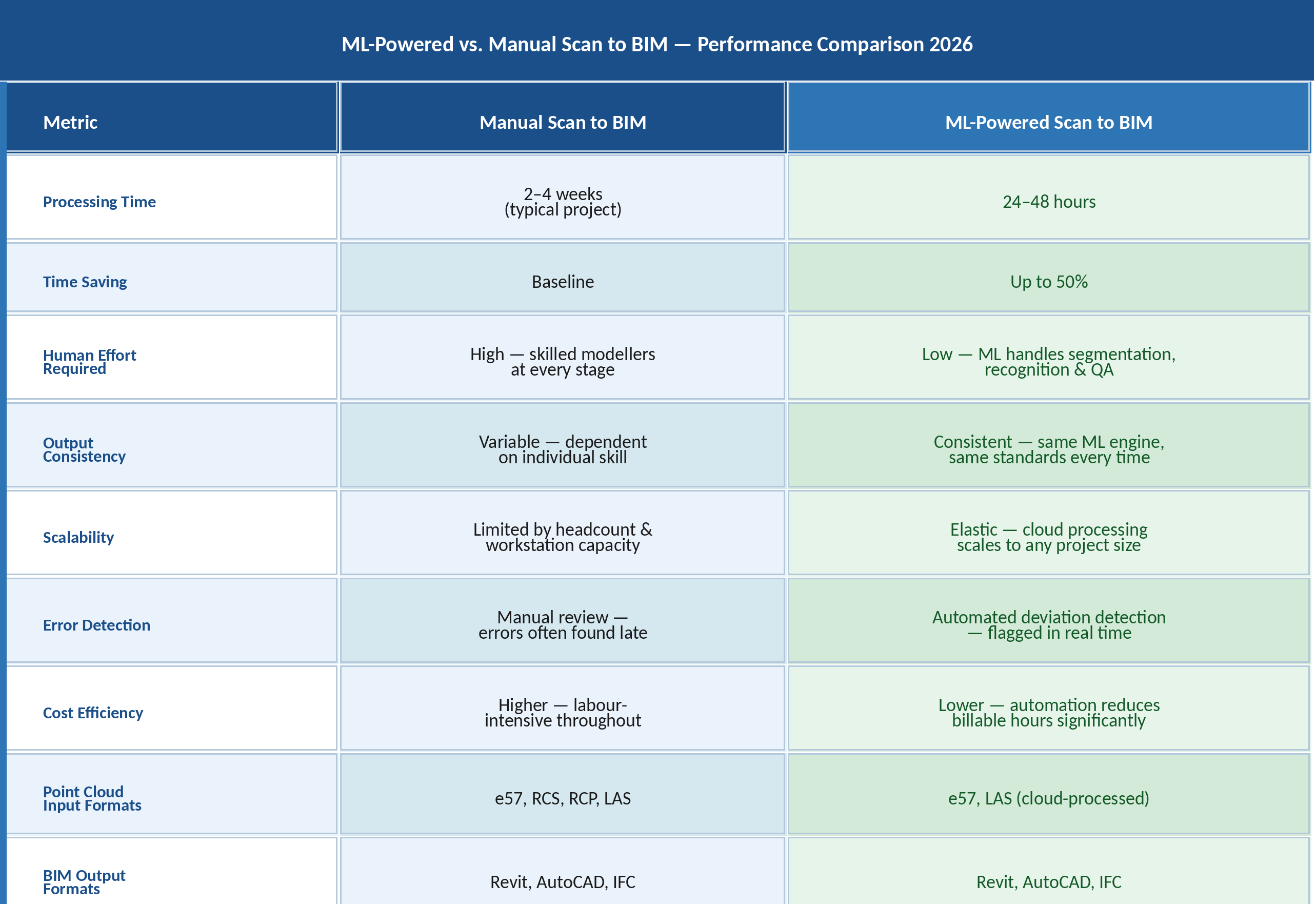
The conclusion is clear: for any project where time, cost, and accuracy are priorities — which is every project — ML-powered scan to BIM delivers a measurably superior outcome.
For a deeper analysis of these workflow differences, see: How nCircle Automated Scan to BIM Using Machine Learning.
How Much Does Scan to BIM Service Cost in 2026?
Scan to BIM service costs in 2026 typically range from approximately USD 0.05–0.15 per square foot for ML-automated workflows on standard residential or commercial projects, rising to USD 0.20–0.50+ per square foot for manual or MEP-intensive work.
Exact pricing depends on project size, Level of Detail required, scan data quality, MEP scope, and turnaround timeline.
Factors that directly influence your scan to BIM quote:
- Project size and scan coverage — A single residential floor plate and a multi-storey commercial building or infrastructure corridor are priced very differently. Total scanned area and number of point cloud files both affect cost.
- Level of Detail (LOD) — LOD 200 models require significantly less effort than LOD 350 models. Defining your LOD requirement upfront prevents scope creep.
- Scan data quality — Clean, well-registered point clouds with low noise convert faster and cheaper. Raw scans with registration gaps or incomplete coverage require preprocessing that adds cost.
- MEP scope — Including mechanical, electrical, and plumbing system modelling adds substantial complexity. MEP-inclusive models take longer to process and cost more regardless of workflow type.
- Manual vs. ML-automated workflow — ML-powered workflows are significantly more cost-efficient because they replace the most labour-intensive stages with machine time. The cost advantage of automation is greatest for large, complex, or MEP-rich projects.
- Turnaround deadline — Standard delivery timelines are most cost-efficient. Expedited 24-hour delivery carries a premium.
For a project-specific quote, contact nCircle Tech's team directly. For a real example of rapid delivery, see: BIM Model Delivered from Scanned Data Within a Day Using ML-Based Scan to BIM Automation.
The nCircle Tech Advantage — Powered by scantobim.ai
nCircle Tech's ML-powered scan to BIM capability is a production-grade platform deployed on live projects across the US, Europe, India, and Japan. The core of the offering is scantobim.ai — a cloud-based, ML-driven platform that combines machine intelligence with human expertise to produce results that neither can achieve alone.
What defines scantobim.ai in 2026:
- ML engine trained on 800+ GB of point cloud data — spanning residential, commercial, industrial, and infrastructure environments across multiple countries and building typologies
- Continuous learning architecture — the engine improves with every project processed, becoming progressively more accurate over time
- Cloud-based elastic processing — no local hardware dependency, no workstation bottleneck, consistent performance at any project scale
- Input formats: e57 and LAS point cloud files
- Output formats: Revit (RVT), AutoCAD (DWG), and IFC — delivered coordination-ready
- Human-AI hybrid quality control — ML drives automation; nCircle's expert BIM engineers validate and quality-check every deliverable
- Global delivery capability — nCircle Tech's India-based team provides cost-competitive, high-quality output with time-zone coverage enabling near-24-hour delivery cycles
- Established Autodesk technology partnership — ensuring compatibility with Autodesk Construction Cloud, Revit, and the broader Autodesk ecosystem
In Japan, nCircle Tech operates in established partnership with a leading local scan to BIM provider, making affordable, ML-automated scan to BIM accessible in a market where turnaround speed and cost have historically been the primary barriers — see the Japanese partner case study for detail.
Tools and Products That Power the Full Scan to BIM Pipeline
Speed in scan to BIM is not delivered by a single tool — it is the result of an integrated stack. nCircle Tech's product suite covers every stage of the pipeline:
ML Powered Scan to BIM Plugin
ML Powered Scan to BIM Plugin — Brings ML-powered point cloud segmentation and object recognition directly into the existing Revit workflow. Accelerates the modelling stage without requiring a platform change.
Point Cloud Importer/Exporter for Revit
Point Cloud Importer/Exporter for Revit — Handles import of e57, RCS, and RCP point cloud formats directly into Revit. Removes file conversion friction from the workflow. Built for BIM teams that work with scan data daily
Point Cloud Importer for Vectorworks
Point Cloud Importer for Vectorworks — Extends the same point cloud import capability to Vectorworks users — broadening ML-assisted scan workflows beyond the Autodesk ecosystem.
Deviation nSpector
Deviation nSpector — Automates construction quality control by cross-referencing as-built point cloud data against the design BIM model. Identifies dimensional deviations, generates visual error maps, and completes the scan to BIM quality loop without manual checking.
nBIM — BIM, Point Cloud & GIS Integration Platform
nBIM — Extends the BIM model into a full facility intelligence platform by integrating BIM data with point cloud layers and GIS information. The natural next step after scan to BIM delivery for clients building digital twins or managing infrastructure assets at scale.
BIM Clash Detection and Coordination
Once the scan to BIM model is delivered, multi-discipline clash detection is the natural follow-on step. nCircle Tech's BIM Clash Detection and Coordination service ensures the as-built model is clash-free and ready for design development or construction phase use.
Architectural and Structural BIM Services
For projects requiring full architectural and structural BIM modelling alongside or after the scan to BIM process, nCircle Tech's Architectural and Structural BIM Services deliver the complete modelling scope.
AEC Trends Shaping Scan to BIM in 2026
The scan to BIM market is being shaped by several converging technology and industry trends that AEC leaders need to understand and act on:
AI Agents and MCP Servers in BIM
MCP (Model Context Protocol) servers are enabling AI agents to interact directly with BIM data — querying models, triggering automation, and updating records programmatically. Scan to BIM is increasingly one automated node in a larger, agent-driven digital workflow. Read nCircle Tech's analysis: How MCP Server Will Transform Digital Twins and Asset Lifecycle Management.
Drone-LiDAR Convergence
The integration of LiDAR sensors into drone platforms is significantly reducing the time and cost of large-area reality capture. As scan data collection becomes faster and more affordable, the conversion bottleneck becomes the dominant constraint — making ML-powered scan to BIM automation the critical investment for AEC firms in 2026.
Autodesk Construction Cloud Integration
As AEC firms standardise on Autodesk Construction Cloud, delivering scan to BIM outputs in ACC-compatible formats and integrating scan workflows with ACC project and document management is becoming a standard expectation. nCircle Tech's Autodesk partnership ensures full compatibility at every stage.
Digital Twin as the Primary End Goal
In 2026, the scan to BIM model is almost never the final deliverable — it is the foundation of a digital twin. Building owners, infrastructure operators, and facility managers are treating scan to BIM as the entry point to long-term asset intelligence programmes. This raises the stakes for data accuracy and richness from the very first scan capture.
Conclusion — Speed Is Now a Standard, Not a Differentiator
The question AEC firms should be asking in 2026 is not "can we afford ML-powered scan to BIM?" — it is "can we afford not to use it?"
Manual scan to BIM workflows are no longer competitive. They are too slow for today's project timelines, too expensive for current budgets, and too inconsistent for the data quality, digital twin programmes, and Autodesk Construction Cloud integrations now require. AI and ML have fundamentally changed both the economics and the performance ceiling of point cloud to BIM conversion.
nCircle Tech has been building and refining ML-powered scan to BIM capability since 2012. With scantobim.ai, an ML engine trained on over 800 GB of real-world point cloud data, a proven global delivery record, and deep Autodesk and industry partnerships, nCircle Tech is the partner AEC firms trust when speed and accuracy are non-negotiable.
Ready to unleash speed in your Scan to BIM workflow?
Explore nCircle Tech's Scan to BIM services | Discover the ML-powered Scan to BIM platform at scantobim.ai | Contact the team
Frequently Asked Questions
Q: What is Scan to BIM?
Scan to BIM is the process of converting LiDAR or laser scan point cloud data into an intelligent Building Information Model. It is used for as-built documentation, renovation planning, MEP coordination, digital twin creation, facility management, and infrastructure asset management across the AEC industry.
Q: How does ML-powered Scan to BIM work?
Scan to BIM service costs in 2026 typically range from approximately USD 0.05–0.15 per square foot for ML-automated standard projects, rising to USD 0.20–0.50+ per square foot for manual or MEP-intensive scopes. Key pricing factors include project size, Level of Detail (LOD), scan data quality, MEP inclusion, and turnaround timeline. Contact nCircle Tech for a project-specific quote.
Q: What is the difference between manual and automated Scan to BIM?
Manual scan to BIM relies on human modellers and typically takes two to four weeks for a mid-size project. ML-powered automated scan to BIM completes the same scope in 24 to 48 hours with built-in quality control and higher output consistency.
Q: What file formats does nCircle Tech's Scan to BIM service accept and deliver?
Yes. Scan to BIM produces the accurate, data-rich as-built BIM model that underpins digital twin deployments. nCircle Tech's nBIM platform integrates this BIM data with point cloud layers and GIS information for full facility intelligence and asset lifecycle management capability.
Q: Can Scan to BIM be used for facility management and digital twin creation?
Yes. Scan to BIM produces the accurate, data-rich as-built BIM model that underpins digital twin deployments. nCircle Tech's nBIM platform integrates this BIM data with point cloud layers and GIS information for full facility intelligence and asset lifecycle management capability.
Q: What are the benefits of ML-powered Scan to BIM over manual methods?
The primary benefits are speed (24–48 hours vs 2–4 weeks), cost efficiency (fewer billable modelling hours), consistency (same ML engine, same output standards on every project), scalability (cloud-based elastic processing handles any dataset size), and built-in quality assurance (automated deviation detection rather than late-stage manual review).
Q: Which industries use Scan to BIM services most in 2026?
The highest-demand sectors in 2026 are: commercial real estate renovation and retrofit, MEP-intensive industrial facilities, infrastructure and civil engineering (bridges, tunnels, rail), facility management and smart building programmes, and construction quality control for large general contractors.