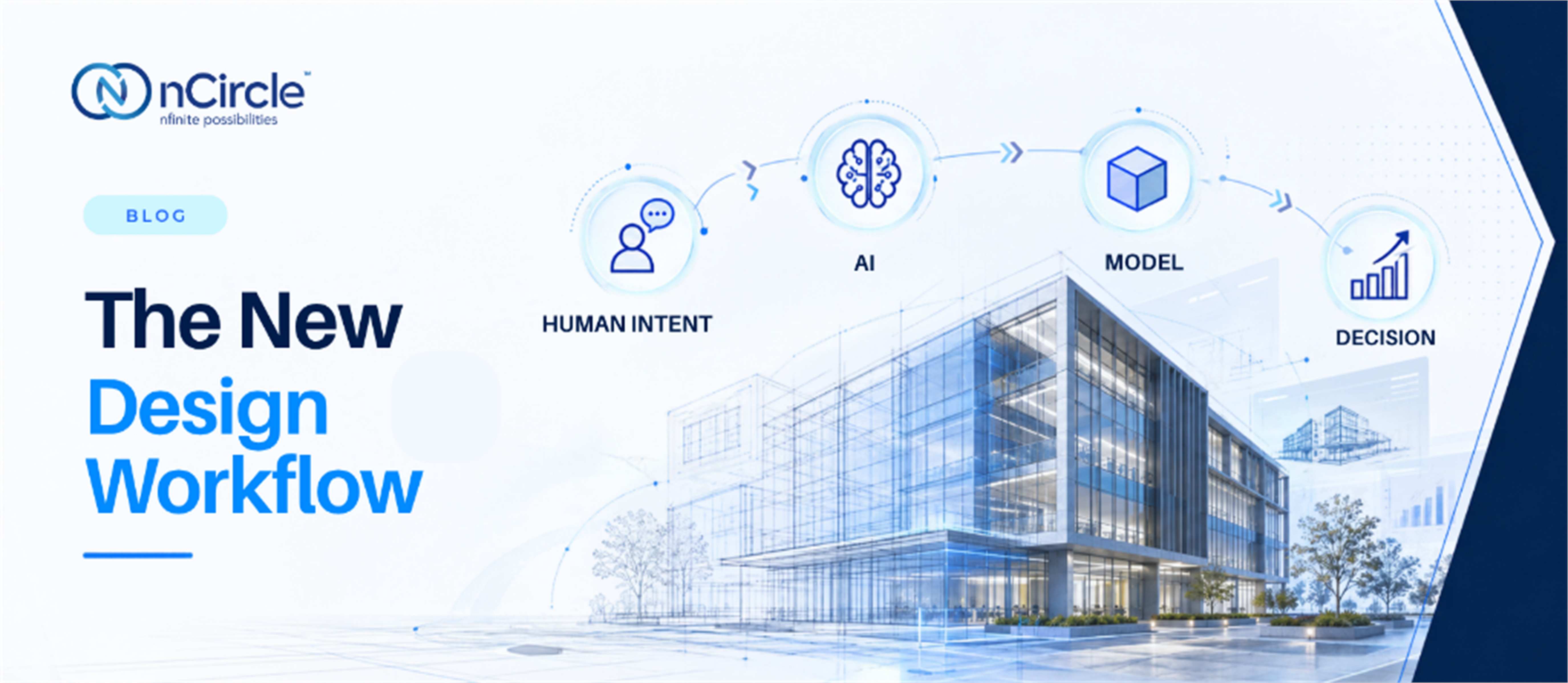
AI Design Workflow AEC: Human Intent - AI - Model - Decision
Most conversations about AI design workflow AEC teams are building right now start in the wrong place. They start with the tool. A better starting point is the sequence the tool sits inside: human intent, AI, model, decision. Get that order wrong, and the tool doesn't matter.
1. Why AEC Needs a New Mental Model for AI
The old workflow was simple: a person had an idea, built a model, and made a decision based on it. AI doesn't just speed up that sequence - it inserts itself into the middle of it, translating intent into options before a model even exists. Treating AI as a faster version of the old workflow misses this. The shape of the workflow itself has changed, and any AI design process AEC teams adopt needs to account for that shape, not just the speed of gain.
2. The Four-Part Framework
The framework for this workflow is divided into four stages.
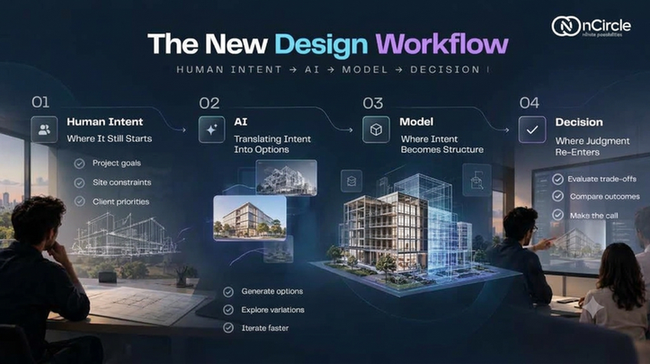
1. Human Intent - Where It Still Starts
Every project starts with judgment a machine doesn't have: a design goal, a site constraint, a client's unstated priority. AI has nothing to translate until a human articulates what actually matters here. This is the one stage in the sequence that hasn't changed at all.
2. AI - Translating Intent Into Options
This is where AI in architectural decision-making actually earns its place - not by deciding anything, but by turning a stated intent into a range of plausible options faster than a person could sketch them by hand. Pattern recognition, generation, rapid iteration: useful, but still upstream of a real decision.
3. Model - Where Intent Becomes Structure
The BIM model is where intent, once filtered through AI, becomes something structured and shareable. This is also where AI-assisted BIM modeling shows up most visibly - not replacing the model, but changing how quickly and completely it reflects the intent behind it.
4. Decision - Where Judgment Re-Enters
A model doesn't decide anything. A person looks at what the model shows, weighs trade-offs the model can't weigh on its own, and closes the loop. This stage is nonnegotiable, and any workflow that quietly skips it isn't using AI - it's outsourcing judgment it shouldn't.
3. What Changes When You Follow This Order
Breaking away from the usual pattern and adopting this workflow ushers in two important changes.
AI Stops Being a Black Box
When you can name which stage you're in, you can also ask a stage-specific question: is this an intent problem, an AI-output problem, or a modeling problem? That's a very different conversation than "why doesn't the AI just work."
Decisions Stay With People
This human intent AI framework makes one thing explicit that most AI marketing quietly blurs: decision is never the AI's stage. Naming it protects accountability - someone can always point to where in the sequence a call was actually made.
4. Where This Framework Breaks Down
No framework survives contact with real iteration cleanly. In practice, a model often reshapes the original intent - a constraint AI surfaces mid-process can send a team back to redefine what they wanted in the first place. The sequence isn't always linear; sometimes it's a loop that runs through twice before a decision is stable enough to act on.
5. Applying the Framework to Your Own Workflow
The useful exercise isn't adopting this framework wholesale - it's using it as a diagnostic.Walk your last project through it: was intent actually clear before AI got involved? Did the model faithfully carry that intent forward, or did something get lost in translation? Most workflow breakdowns in AEC trace back to one weak stage, not a bad tool - and once you can name the stage, you can actually fix it instead of blaming the software.
That's the real value of thinking in terms of an AI design workflow AEC teams can actually audit, stage by stage, rather than an AI role in construction workflows treated as one big undifferentiated upgrade.
The order matters more than the tool. A model is only as honest as the intent behind it, and a decision is only as good as the judgment applied at the very end - no matter how much AI sits in between.
Where in your own process does intent quietly get lost before it reaches a decision?
Curious about what AI could mean for the future of Design & Make?
Tarika Jain, Co-Founder and Head of Business at nCircle Tech, explored this perspective at AU2026 on September 14, in her session, “What AI in Design & Make Looks Like.”
6. Frequently Asked Questions
What is the human intent to AI to model to decision framework?
It's a four-stage way of mapping how AI fits into design: a human sets intent, AI translates it into options, a model structures the result, and a person makes the final decision.
How does AI fit into the AEC design workflow?
AI sits between intent and the model - generating and filtering options faster than manual methods, without originating the goal or making the final call itself.
Does AI replace human decision-making in architecture and construction?
No. In this framework, decision-making stays entirely human - AI accelerates the stages before it, but the final judgment call remains a person's responsibility.
What is the difference between AI-assisted design and AI-automated design?
AI-assisted design keeps a human decision at the end of the loop; AI-automated design removes that checkpoint, which is exactly the stage this framework argues shouldn't be skipped.