
The Impact of AI on the AEC Industry: Empowerment vs. Replacement
The introduction of artificial intelligence has shaken things up in several industries and the AEC sector is no exception. With almost 68% of businesses either adopting or planning to integrate AI into their workflow, its influence is undeniable according to Deloitte study.
When it comes to the AEC industry, AI exhibits potential in terms of enhancing efficiencies, minimising errors, and transforming conventional methods into advanced strategies. Yet, this raises a critical question among professionals: Will AI empower or replace?
Let’s learn all about its potential and unveil the real picture.
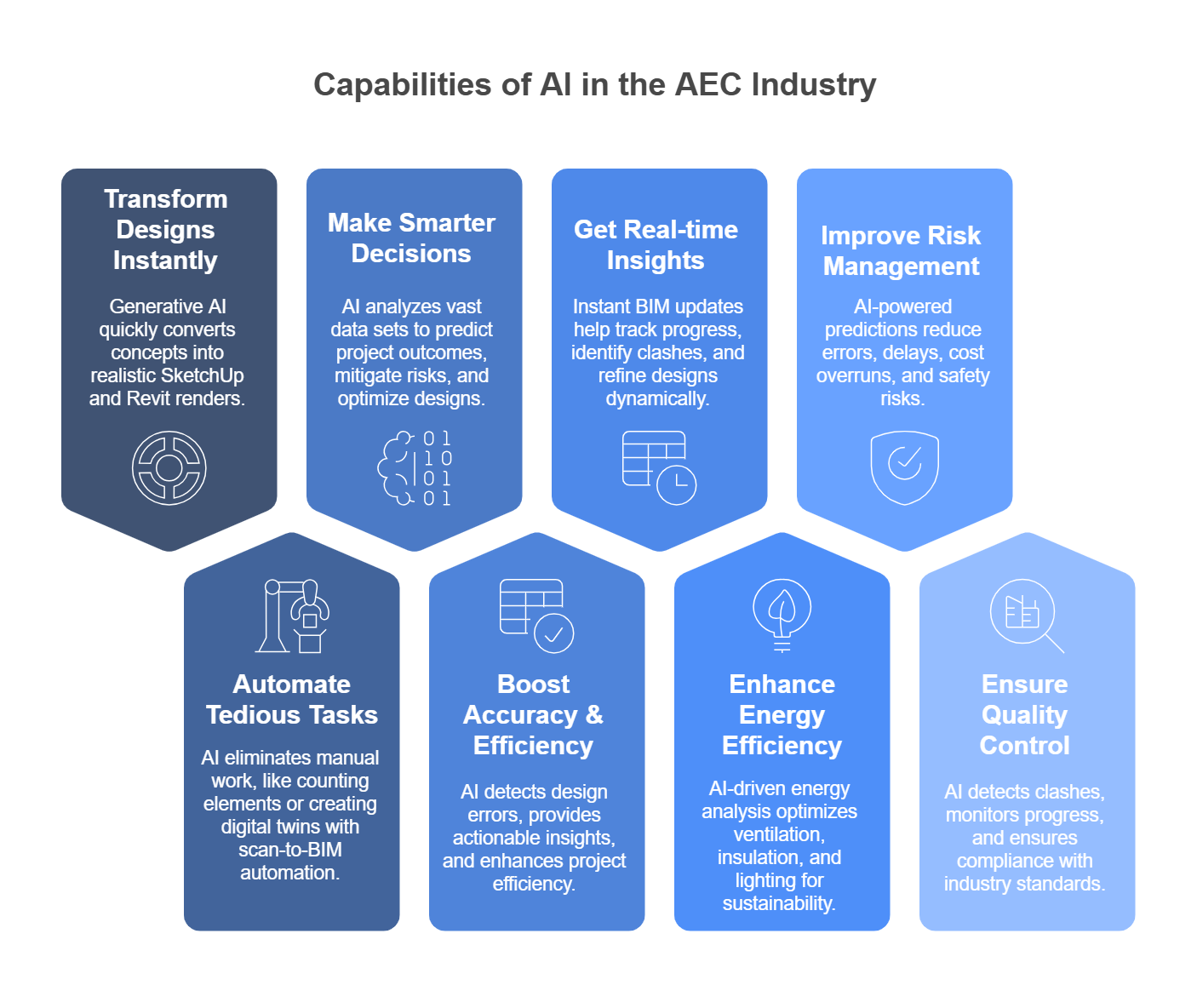
The Capabilities of AI in the AEC Industry
The AI market in construction management is expected to reach a value of about 4.5 billion USD by 2026, underscoring its growing potential to transform typical workflows. Let’s delve deep into how AI tools are reshaping the industry.
The Challenges AI Brings to the Industry
While AI can enable quicker results and better efficiency, several critical challenges hinder its adoption.
1. Initial Upfront Cost
One of the biggest implementation challenges for AI in AEC industry is high cost. Companies must implement AI platforms, BIM tools, and advanced hardware to ensure smooth functionality, making the initial costs a major barrier to adoption.
2. Reskilling Staff
As the technology advances, your staff needs to upgrade, too. The traditional practices have resulted in a hesitancy toward switching the work models. Companies need to invest in reskilling initiatives or hire experts proficient in machine learning, data science, and automation.
3. Need for Standardised Data
AI relies on high-quality data to give accurate results. However, in the AEC industry, data often remains fragmented due to varied formats and organisational standards. This lack of uniformity creates challenges in data restructuring, interoperability, and seamless AI integration.
4. Unethical Usage
AI-powered tools process vast amounts of sensitive project data, raising concerns about cybersecurity, unauthorised access, and potential misuse. Ethical AI deployment requires strict data protection measures and responsible usage policies.
5. Losing Creative Control
Today, many designers rely on generative AI’s visualisation powers for quick designs and faster iterations. However, this convenience comes at the cost of designers losing creative control. AI-driven tools may generate solutions lacking personalisation and human touch.
AI– An Inspiration than a Threat
AI in AEC is a way to free professionals from repetitive tasks, allowing them to focus better on the critical and strategic decision-making that AI isn’t capable of.
For instance, with the automation of 2D to 3D modelling, professionals can redirect their time and expertise toward innovative design, client interactions, site coordination, and complex problem-solving. Additionally, generative AI opens opportunities to experiment with unconventional ideas, when co-created with tech capabilities and human touch.
With technologies continuing to evolve, efficiency lies in a strong collaboration between manual and automated.
An AI-enhanced Future
Investing in the latest technology is the way forward. Businesses that have adopted advanced technology report improvement in revenue growth by 1.4% better results, and 1% higher profit according to Deloitte study.
AI promises on-time project delivery, budgeted operations, and overall efficiency. The future is all about a collaboration between humans and automation paving the way towards a smarter and sustainable AEC future.
Are you ready to automate and elevate your AEC game? Take the first step towards a smarter workflow with nCircle Tech.
FAQs
1. What is the role of AI in AEC?
AI in the AEC industry automates repetitive tasks, minimises errors, enhances decision-making, and improves overall efficiency.
2. How is machine learning becoming a part of construction?
The algorithms developed with machine learning help in real-time predictions for buildings’ energy and operation analysis based on altering conditions.
3. Can AI take over the jobs of AEC professionals?
AI is designed to collaborate with AEC professionals, not replace them.