Leveraging Point Cloud Data for Digital Asset Management
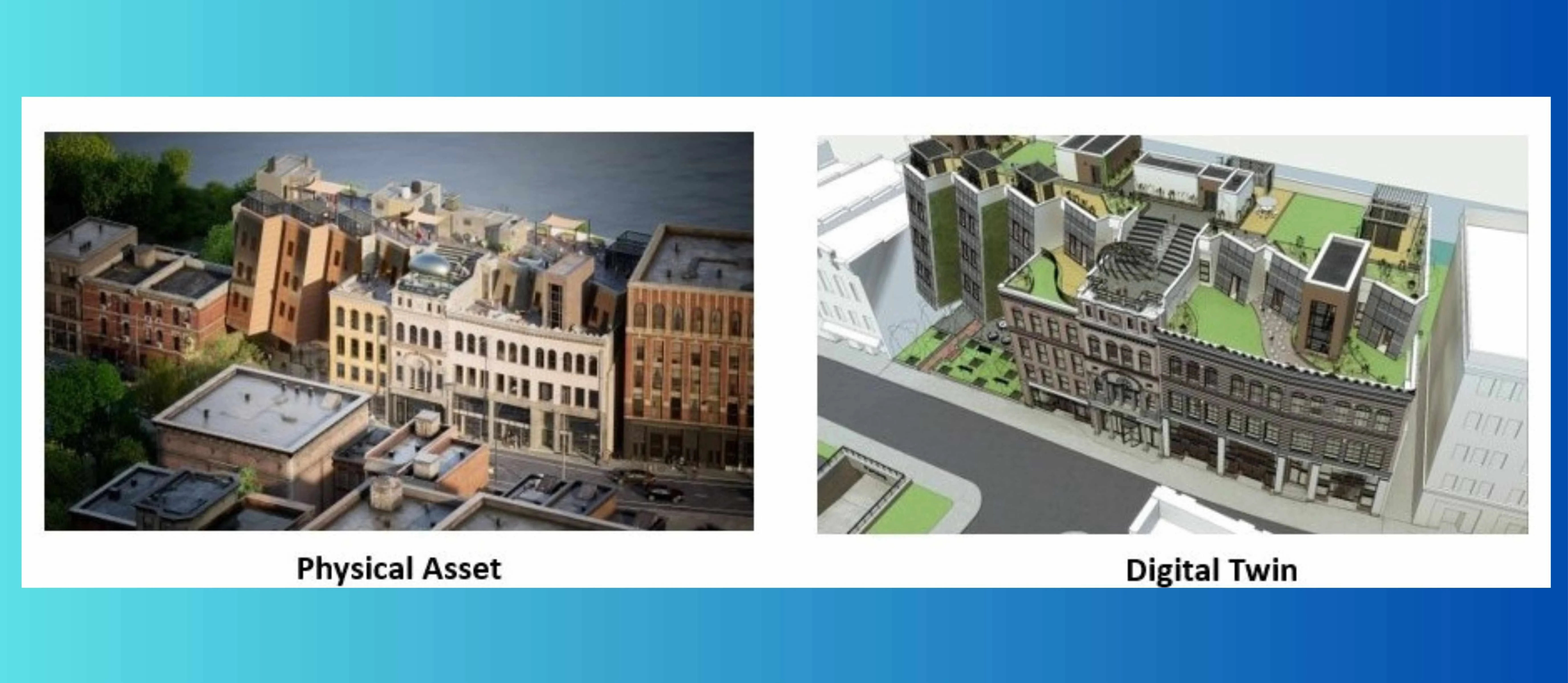
The revolutionary technology of Digital twins has significantly gained recognition and popularity in recent years. While they’re virtual representations of real-world objects, processes, or systems, they come in various forms.
Created using a combination of an array of data services and systems, simulates physical entities in a digital environment. Mirroring the behaviour and status, their primary focus is on gaining insights on improving and optimising performance.
Integrating data from IoT devices, sensors, and other data sources, helps to monitor and optimise assets creating highly accurate and up-to-date digital representations that can be used for operations, analysis, maintenance, and efficiency.
Digital Twins and BIM
While BIM is the digital representation of a building structure and functionality, Digital twin is enriched with data captured from the asset and synchronised to the virtual representation. BIM models are converted into digital twins by enriching them with real-time data that is directly synced from the asset.
Data is continuously captured through a range of technologies, such as sensors, smart meters, and monitors, and then transmitted to the digital twin. This ensures that the digital twin remains an accurate, real-time virtual representation of the physical asset. Without synchronized data, a digital model cannot be considered a true digital twin.
Digital Twins and Point Clouds
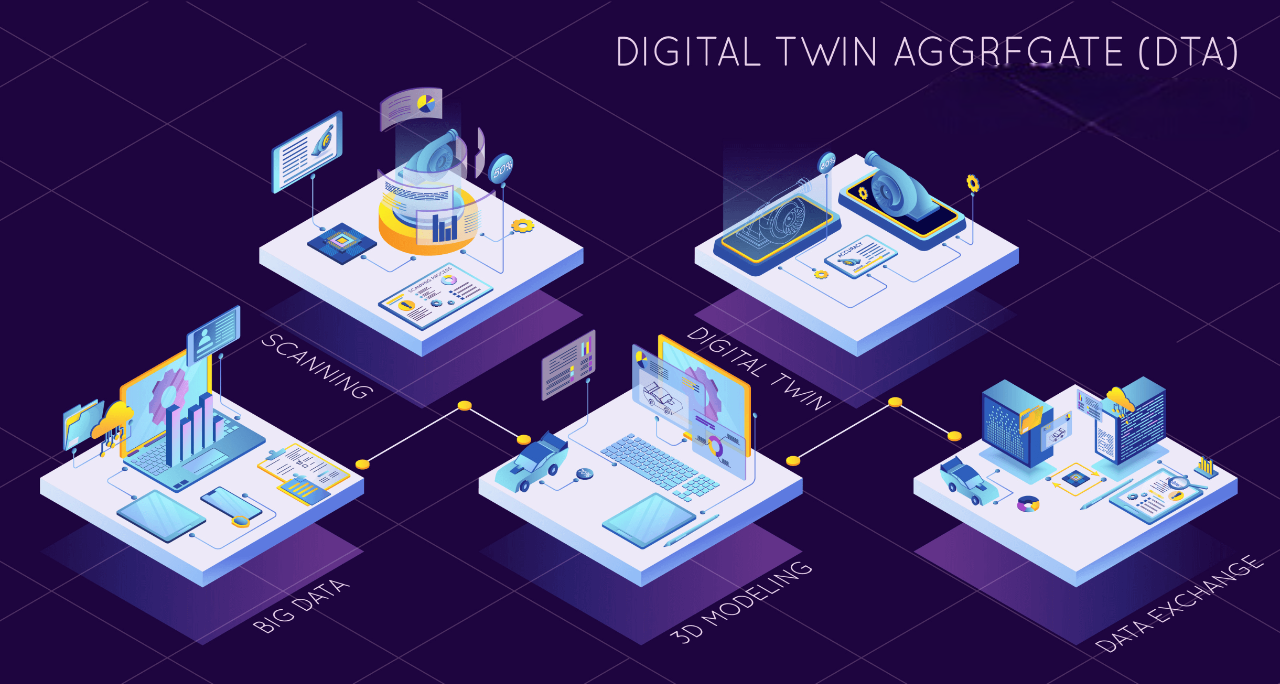
The main components of a digital twin are its static data and dynamic data. Static data is a fixed data set that remains consistent, whereas the dynamic dataset is constantly synced and updated between physical assets and virtual representations. While point clouds are collected data points of a structure, they accurately represent the physical structure.
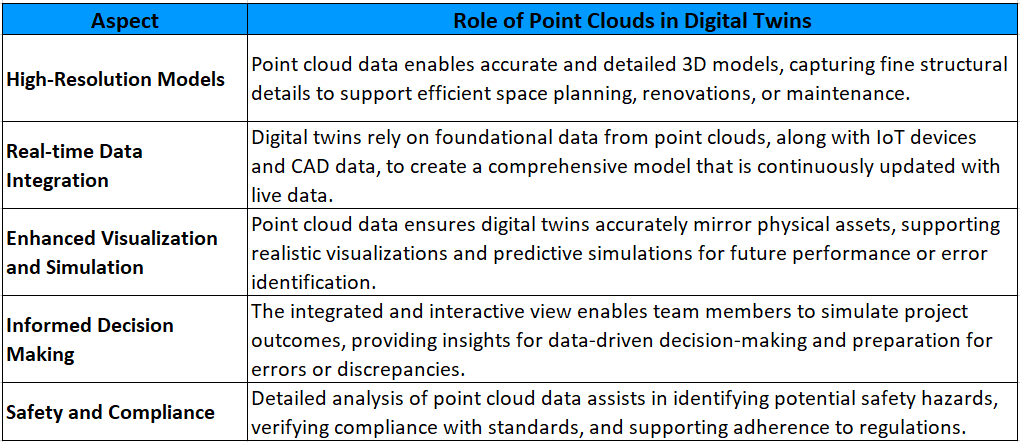
Point cloud scans form the structure’s foundation for the realistic and accurate creation of the digital twin. They play a crucial role in the development of digital twins by contributing in ways like
Applications
- Manufacturing Industry: Digital twins are used to design and test products before they are physically produced, improving product development efficiency and accuracy.
- Energy Sector: Digital twins help optimize energy production and distribution by simulating systems and identifying areas for improvement.
- Automotive and Aerospace Industries: Used to design, simulate, and test products to ensure safety, performance, and structural integrity before production.
- Urban Infrastructure: Digital twins model transportation systems, buildings, and public spaces, allowing city planners to design efficient, data-driven urban environments.
Challenges in Integrating Point Cloud Data for Digital Twins
- Large Data Volumes: Point cloud files are large and need advanced processing and storage to integrate smoothly.
- Real-Time Syncing: Digital twins rely on up-to-date data from sensors, requiring constant, accurate updates.
- Complex Data Integration: Merging point cloud data with existing data is challenging, especially for large projects.
- Skilled Expertise Needed: Creating digital twins requires trained professionals in data analytics and modeling, necessitating investment in training or hiring.
Despite the challenges, digital twins are certain to hold a promising development with the help of AI and interconnectivity. Through end-to-end details provided, the digital twin representation will incorporate even the smallest and most intricate detail, capturing features incredibly. The high level of precision helps in a true reflection of the real-world conditions and structures as a digital twin.
Offering a virtual window into the physical world, it is creating a revolutionary change as organisations continue to invest in this to create and redefine an innovative future.
To discover how digital twins can transform your business, visit nCircle Tech and explore our cutting-edge solutions and services.