
From Physical to Digital: How the AEC Industry Is Transforming Asset Management with Digital Twins and Smart Workflows
Managing large-scale built assets across geographically distributed portfolios should no longer be constrained by legacy tools and fragmented systems. And yet, many AEC firms despite digital ambitions still navigate operational complexity through outdated practices like spreadsheets, disconnected CMMS logs, or hand-marked PDFs, rather than leveraging advanced solutions like Digital Twin technology or BIM + IoT integration for smarter Facility Management.
These legacy workflows lead to significant inefficiencies: obsolete data, siloed teams, and reactive decision-making. In the absence of a Common Data Environment (CDE), Digital Twin for Asset Management, or ISO 19650-aligned frameworks, even advanced digital models often fall short of their potential.
Today, the transition to integrated digital asset management (DAM) is not simply a technological upgrade; it’s a strategic necessity, driven by emerging trends like Digital Twin for Asset Management, QR-based asset tracking, and BIM + IoT integration.
Why Traditional Asset Management Is No Longer Sufficient
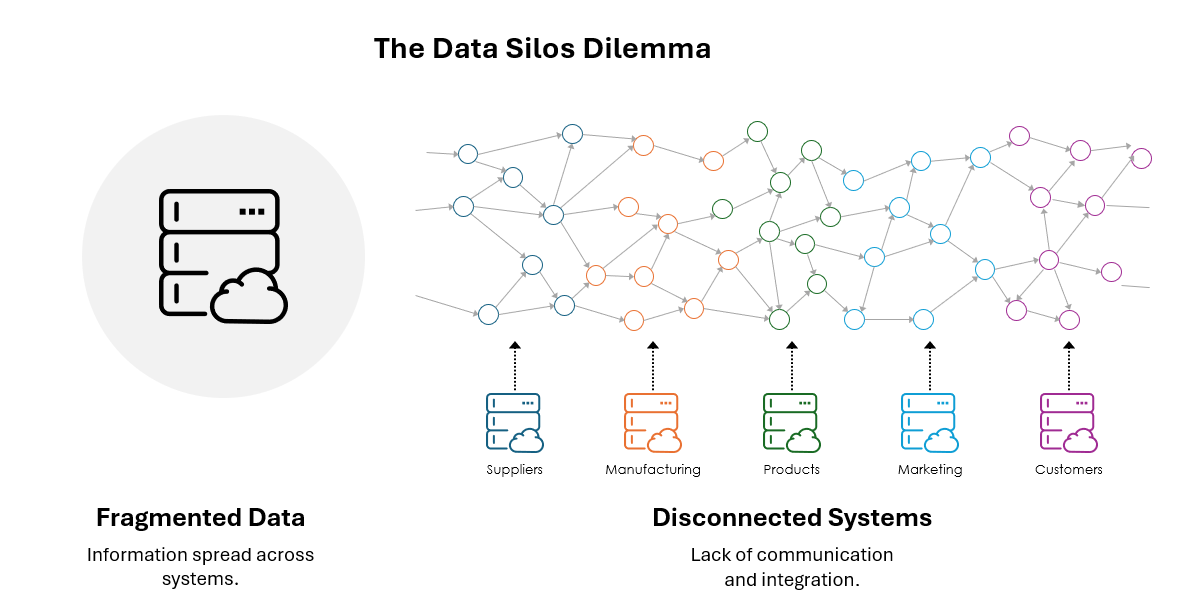
Legacy tools fail not due to lack of intent, but due to architectural fragmentation:
- Spatial data remains locked in static BIM files or isolated PDFs
- Operational data lives in siloed CMMS or manual logs
- Compliance data is disconnected from real-time usage or location
This decoupling limits cross-team visibility, slows down collaboration, and makes predictive planning impossible. The result: fragmented handovers, costly rework, and underutilized data assets.
Key industry challenges include:
- Complexity - High asset volume, diverse building typologies, and dispersed locations
- Efficiency - Manual service scheduling, error-prone tracking, poor integration
- Sustainability - ESG metrics and energy data often disconnected from spatial operations
As noted in AECBytes, despite widespread BIM adoption, many facilities teams still rely on printed schedules, undermining the value of data-rich models.
What Integrated DAM Actually Looks Like
Integrated asset management is not a software purchase - it’s a system-wide process redefinition. It aligns design, construction, and operations through connected platforms, real-time insights, and interoperable data.
From PDFs to Federated Models
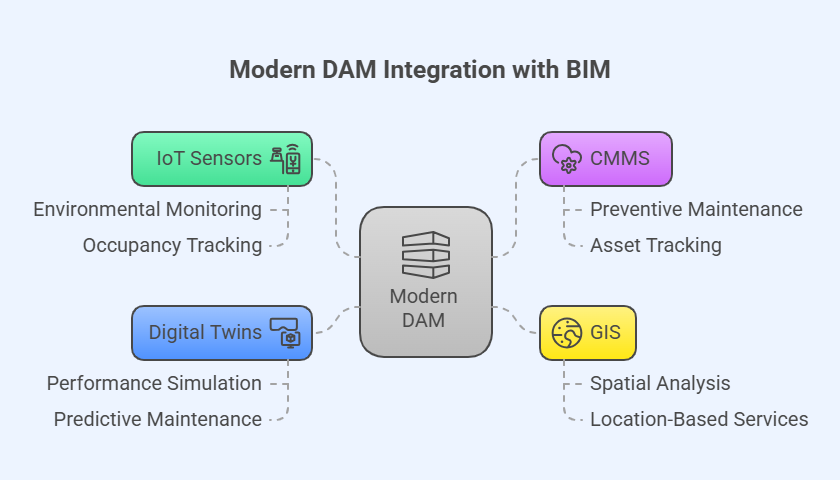
Modern DAM leverages structured BIM models, integrated with:
- IoT sensors for live performance metrics (BIM + IoT integration)
- QR-based asset tracking for physical-to-digital connectivity
- CMMS for condition-based maintenance triggers
- GIS and spatial overlays for operational context
- Digital Twin for Asset Management to model, simulate, and respond to asset conditions in real time
Case Example:
Enterprise like WeWork use QR-based BIM tagging connected to platforms like Autodesk Tandem and Power BI, enabling asset tracking, condition monitoring, and predictive maintenance, all without opening full models
The Role of Automation and APS in Scalable DAM
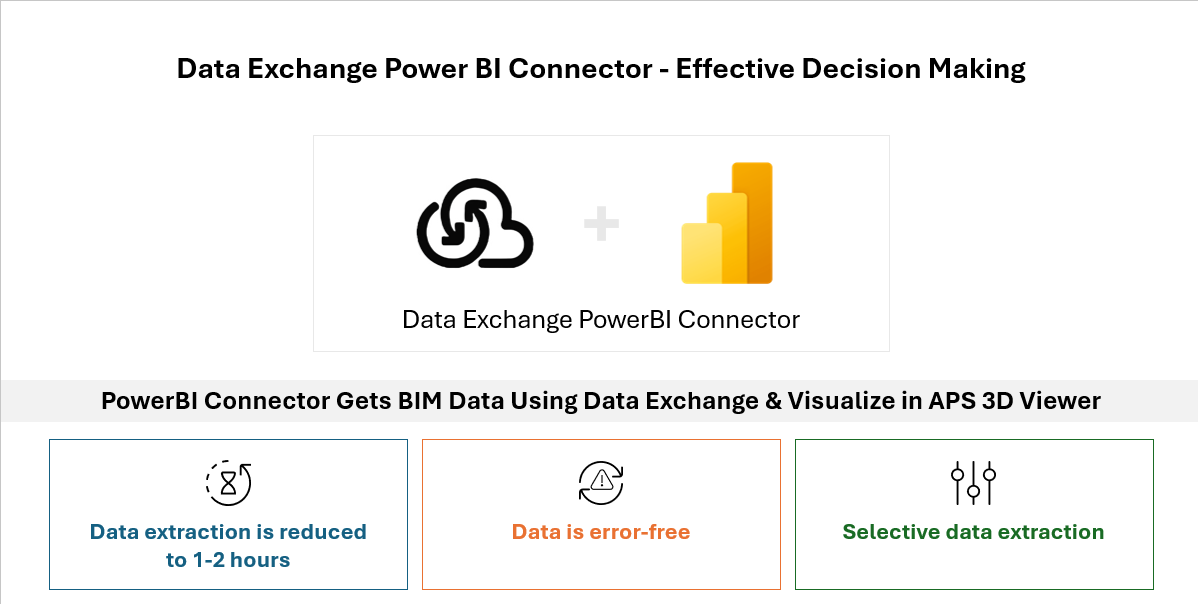
At nCircle Tech, we’ve observed that automating data workflows unlocks the real ROI of BIM. Our CAD-BIM automation pipelines push structured data from tools like Revit into Power BI dashboards, enabling real-time asset visibility - from HVAC usage patterns to lifecycle cost monitoring.
Using Autodesk Platform Services (APS), particularly the Data Exchange API, teams can selectively extract and manage model data without loading entire files, making asset workflows more nimble, accurate, and scalable, and paving the way for true Digital Twin for Asset Management.
Benefits include:
- Dynamic model updates with IoT inputs (BIM + IoT integration)
- QR-based asset tracking for real-time asset visibility
- Visual dashboards with spatial and performance data
- Live CMMS alerts triggered by real-time wear data
- Automated clash detection and BIM handover validation
This creates a closed-loop system where design, operations, and analytics interact continuously - minimizing manual overhead and maximising insight.
Why It’s Time to Rethink Spreadsheets and Static Reports
As portfolios grow and compliance tightens, physical documentation and disjointed databases fail to scale. Digitisation is no longer about scanning drawings - it’s about building structured, query-ready environments that serve every stakeholder: from architects to asset managers.
With BIM-linked QR codes, RFID tags, and API-enabled CMMS platforms, every asset becomes a node in a live operational network - updatable, searchable, and auditable.
Moreover, with natural language search capabilities powered by tools like ChatGPT, even non-technical users can extract insights from complex models - enhancing cross-functional collaboration.
Implementation: Where to Begin
For teams ready to scale into digital asset management, here’s a strategic roadmap:
- Audit existing tools and data environments: Identify inefficiencies, silos, and redundancies.
- Integrate spatial and operational data: Use QR or RFID tagging in BIM models linked to live CMMS systems.
- Deploy APS + Power BI stack: Connect Revit/IFC data into live dashboards for real-time decision-making.
- Enable language-based query systems: Use ChatGPT-powered interfaces to democratize access to model intelligence.
- Engage experienced automation partners: nCircle Tech offers CAD/BIM workflow implementation and APS integrations tailored to your operational maturity and compliance needs.
Final Thought: Strategic Asset Intelligence is the Future
Physical logs and disconnected files no longer meet the pace and performance demands of modern asset management. Forward-looking firms are already investing in Digital Twin for Asset Management, QR-based asset tracking, and BIM + IoT integration to gain strategic clarity and operational resilience.
Those who implement structured, automated workflows today won’t just keep up - they’ll lead.
Ready to move beyond spreadsheets?
Talk to nCircle Tech - our specialists help AEC and manufacturing firms build, BIM-powered workflows that scale with your operations.